
Showing posts with label dignity. Show all posts
Showing posts with label dignity. Show all posts
Monday, January 4, 2010


Thursday, January 1, 2009
New year resolution number three: changing the attitude that people with disabilities are expendable
...or that their lives are worth less.
Medics caught on tape allegedly decide disabled man not worth saving
A disabled 59 year old man who called EMT's for help collapsed by the time an ambulance arrived and the medics were allegedly overheard making remarks "to the effect that he was not worth saving" over the open phone line. They made comments about the state of his house. The article states they talked about it and agreed to say the man was dead when they arrived.
See the poem How? by Dan Wilkins
Fear Not the Disabled
Grim News to Start 2009: Bad Cripple
If Disabled Means Expendable
Medics caught on tape allegedly decide disabled man not worth saving
A disabled 59 year old man who called EMT's for help collapsed by the time an ambulance arrived and the medics were allegedly overheard making remarks "to the effect that he was not worth saving" over the open phone line. They made comments about the state of his house. The article states they talked about it and agreed to say the man was dead when they arrived.
See the poem How? by Dan Wilkins
Fear Not the Disabled
Grim News to Start 2009: Bad Cripple
If Disabled Means Expendable
Friday, October 24, 2008
New to the blogroll: PhilosopherCrip
PhilospherCrip blogs on a variety of topics, including disability history, politics, and others, but it was his post about the wild west approach we all take toward independence and disability and life that caught my eye.
He writes:
Like the romanticized settlers of the western frontier, folks with disabilities are blazing a trail into a new territory, as rugged individuals. Relying on their own mettle, they take risks and reap rewards accordingly.
He writes:
Like the romanticized settlers of the western frontier, folks with disabilities are blazing a trail into a new territory, as rugged individuals. Relying on their own mettle, they take risks and reap rewards accordingly.
Of course, this is also somewhat problematic. This emphasis on the value of the individual is a double edge sword as it largely contributes to the very core of the bigotry of ableism. Interconnectedness and interdependence are the values that will free our people, not individualistic, libertarian ideology. In fact, these values are realities for all Americans that are often ignored. American culture tells us there is shame in having someone help you dress if you need it, but having someone else cut your hair is par for the course. We have this mythology that we are individuals that survive in a harsh world on our own. When folks with physical and cognitive differences need help in different ways, their lives are disvalued as having less quality or dignity.
While our freedoms have a uniquely American flavor, so do some of our oppressions. We need to look elsewhere if we are to understand how we can think outside of this box and move away from this kind of marginalization.
Yes, yes, read on....
Friday, May 2, 2008
There's always next year
My cat didn't submit a post to BADD yesterday, but this one did.
And if that cat lived in Switzerland, she would have even more rights, as do goldfish and other social animals, who now are entitled to companions.
Social animals. Humans are social beings, but how odd that a goldfish who doesn't have a companion now has a right to , but we're still working so that people with disabilities can get out of institutions and out of their homes to have a chance of being around companions, to have a social life.
How about this one? Mercator writes that "decapitation of wild flowers at the roadside without rational reason" is essentially a crime. In fact, the committee was unanimous in its agreement that any "arbitrary harm caused to plants[is] morally impermissible."
Decapitating a flower is hard to get upset about , even though I like flowers, when I consider the waste of the talents of so many people with disabilities. I see potential lopped off every day and it's no different than taking a machete to hopes and dreams.
Arbitrary harm caused to plants is morally impermissible? Maybe we need a far-reaching law like that for humans so we realize causing arbitrary harm to each other is wrong too, not just the crimes we have written in our law books, but the kinds of arbitrary harm that result from racism, sexism and, yes, ableism.
Switzerland allows assisted suicide in a place ironically named Dignitas . And now to kill a goldfish you have to use special chemicals because flushing them down the toilet is undignified. As the article points out, there's about as much bureaucracy involved to kill a human being. Dignity.
We have to be very careful about doling out dignity when it comes to human beings. If we put ourselves in the position of playing God, who gets to be treated with dignity? Look at history. Look at our social policies. How do we treat the most vulnerable among us? In ways that cause us the least amount of resources, time and energy? Or do we consider their needs and treat them the way we would want to be treated? Do we institutionalize people with disabilities because it's easier? It's not more cost efficient. It costs less to have people living in the community. But that requires change: access to housing, transportation, jobs, inclusion in our churches for those who want to attend. It means seeing disability. And seeing disability is part of inclusion.
Yesterday when I participated in Blogging Against Disablism Day 2008 , I was struck by the small number of people who participated in BADD 2008 who are not disabled or the parent of a child with a disability. I know it might feel uncomfortable for people to submit a post on the issue. You might not know what to say. Perhaps you think you don't belong.
I assure you, you couldn't go to a group who more knows how that feels. After I first acquired my disability, I felt like that whenever I was in a group of people where I was the only one with a disability. Gradually it became easier, although other people didn't always create situations that made it easier. I learned not to count on that so I could have a life.
But it doesn't become easier by just not doing it. And, as I write this, I console myself with the thought that there's always next year. Perhaps more people will take that risk and join us in BADD.
Everyone's welcome, even cats.
And if that cat lived in Switzerland, she would have even more rights, as do goldfish and other social animals, who now are entitled to companions.
Social animals. Humans are social beings, but how odd that a goldfish who doesn't have a companion now has a right to , but we're still working so that people with disabilities can get out of institutions and out of their homes to have a chance of being around companions, to have a social life.
How about this one? Mercator writes that "decapitation of wild flowers at the roadside without rational reason" is essentially a crime. In fact, the committee was unanimous in its agreement that any "arbitrary harm caused to plants[is] morally impermissible."
Decapitating a flower is hard to get upset about , even though I like flowers, when I consider the waste of the talents of so many people with disabilities. I see potential lopped off every day and it's no different than taking a machete to hopes and dreams.
Arbitrary harm caused to plants is morally impermissible? Maybe we need a far-reaching law like that for humans so we realize causing arbitrary harm to each other is wrong too, not just the crimes we have written in our law books, but the kinds of arbitrary harm that result from racism, sexism and, yes, ableism.
Switzerland allows assisted suicide in a place ironically named Dignitas . And now to kill a goldfish you have to use special chemicals because flushing them down the toilet is undignified. As the article points out, there's about as much bureaucracy involved to kill a human being. Dignity.
We have to be very careful about doling out dignity when it comes to human beings. If we put ourselves in the position of playing God, who gets to be treated with dignity? Look at history. Look at our social policies. How do we treat the most vulnerable among us? In ways that cause us the least amount of resources, time and energy? Or do we consider their needs and treat them the way we would want to be treated? Do we institutionalize people with disabilities because it's easier? It's not more cost efficient. It costs less to have people living in the community. But that requires change: access to housing, transportation, jobs, inclusion in our churches for those who want to attend. It means seeing disability. And seeing disability is part of inclusion.
Yesterday when I participated in Blogging Against Disablism Day 2008 , I was struck by the small number of people who participated in BADD 2008 who are not disabled or the parent of a child with a disability. I know it might feel uncomfortable for people to submit a post on the issue. You might not know what to say. Perhaps you think you don't belong.
I assure you, you couldn't go to a group who more knows how that feels. After I first acquired my disability, I felt like that whenever I was in a group of people where I was the only one with a disability. Gradually it became easier, although other people didn't always create situations that made it easier. I learned not to count on that so I could have a life.
But it doesn't become easier by just not doing it. And, as I write this, I console myself with the thought that there's always next year. Perhaps more people will take that risk and join us in BADD.
Everyone's welcome, even cats.
Sunday, April 27, 2008
UK nurses ask for patient dignity measures
8 out of 10 nurses out of a group of 2000 polled said they have left work distressed about lack of patient dignity in their facilities. They cite inadequate equipment and privacy issues where patients of both genders receive care in close proximity among their concerns.
Thursday, April 3, 2008
What is Rocky about?
It's about an individual surviving with his integrity and his dignity intact when the whole of society, including himself, is set up to think of him as a joke and a tool and doesn't really care about what or who he is except to the degree he is useful.
from the post Gonna Fly Now
Oh yeah . Dignity. Needed to be reminded of that this morning.
from the post Gonna Fly Now
Oh yeah . Dignity. Needed to be reminded of that this morning.
Saturday, August 11, 2007
Never try to sell cleaning solution to a quad
So I answer the door.
"Hello," she says, holding up a bottle of Biogeneric environmentally correct solution, "I'm selling cleaning solution."
"Sorry, I don't use it," I reply.
She tries to hand me a flyer.
"Can't hold that," I say. "My hands are paralyzed."
"Both?"
I look down. "Yup." Figured I'd check, just to see if there'd been a change. "Look, I don't clean."
"Well," she says, putting on a chipper look, "someone must clean FOR you, so wouldn't they want a bottle of this?"
I think of Meredith and can hear her say "You only bought this because you felt sorry for the person, right?" and I reply "No, not really. I don't have any use for it. But I do have cold bottled water - would you like one?"
"Oh yes," she says. She looks frazzled, hot and very tired. So I bring her a bottled water in the crook of my elbow and she watches my every move. (Looking back, I think she was considering if she could convince me I could hold a mop that way and clean and then I would need cleaning solution.)
But she just said "What's your name?" and I told her. Then she said "Thank you, Ruth."
So I suppose, in a way,I wound up giving her a break from being treated like a door to door saleswoman rather than a person. And I realized, after she left, that perhaps that's one of the reasons why I offer people cold water in the heat.
"Hello," she says, holding up a bottle of Biogeneric environmentally correct solution, "I'm selling cleaning solution."
"Sorry, I don't use it," I reply.
She tries to hand me a flyer.
"Can't hold that," I say. "My hands are paralyzed."
"Both?"
I look down. "Yup." Figured I'd check, just to see if there'd been a change. "Look, I don't clean."
"Well," she says, putting on a chipper look, "someone must clean FOR you, so wouldn't they want a bottle of this?"
I think of Meredith and can hear her say "You only bought this because you felt sorry for the person, right?" and I reply "No, not really. I don't have any use for it. But I do have cold bottled water - would you like one?"
"Oh yes," she says. She looks frazzled, hot and very tired. So I bring her a bottled water in the crook of my elbow and she watches my every move. (Looking back, I think she was considering if she could convince me I could hold a mop that way and clean and then I would need cleaning solution.)
But she just said "What's your name?" and I told her. Then she said "Thank you, Ruth."
So I suppose, in a way,I wound up giving her a break from being treated like a door to door saleswoman rather than a person. And I realized, after she left, that perhaps that's one of the reasons why I offer people cold water in the heat.
Friday, June 29, 2007
"The Right to Life and Human Dignity" by Leon Kass
..over at the New Atlantis (click above to read the entire article).
He writes:
"Nevertheless, Hobbes seems to me perfectly right to insist on the foundational importance of an individuated human life, and in worrying about the dangers to decency and dignity in making light of the right to life. Those who would, even today, be inclined to disagree, should ponder the human meaning of those seemingly loftier moral outlooks that deny the right to life—outlooks that push millions into gas chambers in order to improve the race, that brutalize and liquidate dissidents in preparation of the coming classless society, that dispatch the elderly and the handicapped newborn, or abort the genetically infirm, in the name of “quality of life,” that call upon doctors to deliver, with the state’s blessing, “death with dignity,” and that mutilate and blow up innocent civilians, all for the glory of God. Hobbes would call this unnatural and crazy, and a denial of natural right. So should we. We must also call it an assault on human dignity."
Well worth reading as it applies to issues of "right to die" , "death with dignity" and assisted suicide laws and futile care laws .
He writes:
"Nevertheless, Hobbes seems to me perfectly right to insist on the foundational importance of an individuated human life, and in worrying about the dangers to decency and dignity in making light of the right to life. Those who would, even today, be inclined to disagree, should ponder the human meaning of those seemingly loftier moral outlooks that deny the right to life—outlooks that push millions into gas chambers in order to improve the race, that brutalize and liquidate dissidents in preparation of the coming classless society, that dispatch the elderly and the handicapped newborn, or abort the genetically infirm, in the name of “quality of life,” that call upon doctors to deliver, with the state’s blessing, “death with dignity,” and that mutilate and blow up innocent civilians, all for the glory of God. Hobbes would call this unnatural and crazy, and a denial of natural right. So should we. We must also call it an assault on human dignity."
Well worth reading as it applies to issues of "right to die" , "death with dignity" and assisted suicide laws and futile care laws .
Tuesday, April 10, 2007
Rutgers Women's Basketball Team- We hold our heads high with dignity...and with respect for ourselves
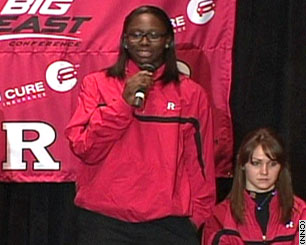
{visual description: Captain Essence Carson of the Rutgers Women's basketball team addresses the audience at the press conference held today.}
Snippets:
Rutgers President : Thank you for being the outstanding ambassadors you are. My heart goes out to each and every one of you.
Coach C. Vivian Stringer:
Let me bring a human face to all of this...I want you to see ten young women who accomplished so much...that we...are so very proud of. These young ladies are valedictorians of their class....future doctors, musical prodigies...girl scouts..the best this nation has to offer and we are so very fortunate to have them here at Rutgers University....young ladies of class, distinction...God's representatives in every sense of the word.
...there are five freshmen...with over a 3.0 GPA...bright ..gifted hardworking. talking about Don Imus story....forgetting what it's ..about....perseverance, hard work...no one believed in them but them. That's the greatest story...I have nothing but pride and respect for them....came back to this..so hurt by the remarks that were uttered by Mr. Imus...we can't let other people steal our joy. ..I was a victim of racial discrimination but I had ...people..who stood up for me..
I would ask...who could hear these comments and not be personally offended? Are women hos? Would you want your daughter to be called that? ...It's about us as a people, black, white, purple or green...the color is green...these aren't political figures...hardworking young women that little girls look up to..bigger issue here...it is all women...have we lost a sense of our own moral fiber?
..i honor and respect their parents who entrust their daughters to me at such a delicate age...so I would ask all of us as adults what is this all about? Are we not responsible...for nurturing their dreams and supporting them? ...What happens when young people do good things and do the right things?..Is there malice in my heart? No, I'm hurt.....despicable words are not right...it's time for everybody to reflect on what's going on..it's been time.
..It took me 25 years to come to a championship game and for once....this was a team that had so little and gave so much...so young.....this was a team that would restore all our faith and confidence in young people. ..we hold our heads with with dignity and ...with respect for ourselves.
Heather Zurich, player:
...we fought, we persevered and most of all we believed in ourselves...but all of our accomplishments were lost, our moment was taken away. We were stripped of this moment by degrading comments made by Mr. Imus..what hurts most is that ...Mr. Imus doesn't know any of us personally...i beleve we present ourselves well... he knows not one of us.
{Each player gets up and introduces herself]
Essence Carson, Captain of team
I would like to express our team's great anger, hurt and disgust...deeply saddened by racial characterization. Imus..brought us to harsh reality ...under brightest lights... has made history...where were these major networks when we ...were making history? ..now we are being bombarded with emails, phone calls..taken a toll on us physically and mentally...we ask that you not recognize us in a light as dim as this....agreed to meeting with Don Imus....private meeting....express our great hurt and sadness this has brought to us...it's about women across the world, across this nation...take a stand..don't look at it as if we're ...attacking {Imus}....we're attacking an issue that we know isn't right.
It isn't right.
As a Rutgers alumna I am proud of these young women and I too am saddened by the fact that the media coverage was not there until the controversy with Imus occurred.
Saturday, April 7, 2007
"Called to be Witnesses, Not Philosophers"
Found this on Mirror of Justice, a blog about Catholic legal theory. Interesting post referring to Stanley Hauerwas' A Community of Character and refers to this passage:
"The task of the Christian is not to defeat relativism by argument but to witness to a God who requires confrontation. .. The command to witness is not based on the assumption that we are in possession of a universal truth which others must also 'implicitly' possess or have sinfully rejected...the command to be a witness is based on the presupposition that we only come to the truth through the process of being confronted by the truth."
I also was glad to re-read this yet again which was in another post:
"We believe that every person is precious, that people are more important than things, and that the measure of every institution is whether it threatens or enhances the life and dignity of the human person. . . In a global culture driven by excessive individualism, our tradition proclaims that the person is not only sacred but also social. The Catholic tradition teaches that human beings grow and achieve fulfillment in community."
-U.S. Bishops, Sharing Catholic Social Teaching: Challenges and Directions
"The task of the Christian is not to defeat relativism by argument but to witness to a God who requires confrontation. .. The command to witness is not based on the assumption that we are in possession of a universal truth which others must also 'implicitly' possess or have sinfully rejected...the command to be a witness is based on the presupposition that we only come to the truth through the process of being confronted by the truth."
I also was glad to re-read this yet again which was in another post:
"We believe that every person is precious, that people are more important than things, and that the measure of every institution is whether it threatens or enhances the life and dignity of the human person. . . In a global culture driven by excessive individualism, our tradition proclaims that the person is not only sacred but also social. The Catholic tradition teaches that human beings grow and achieve fulfillment in community."
-U.S. Bishops, Sharing Catholic Social Teaching: Challenges and Directions
Monday, April 2, 2007
A Kinder Dignity
It's a great word to say out loud and repeat.
Dignity. Dignity. Try different intonations and variations. But what does it mean?
I found the following definitions of dignity on the Web at wordnet.princeton,edu/perl/webwn:
"the quality of being worthy of esteem or respect; formality in bearing and appearance;high office or rank or station"
And there is a lot of talk about dignity. We turn phrases such as "worthy of dignity" "that's not dignified" "if he had any dignity, he wouldn't - " and then we foist our assumptions about a way to be worthy of dignity onto others, a right way to bear ourselves or appear and to whom belongs the right to hold a rank or station in life so as to be considered "dignified".
Lately I've found all this distasteful. I much prefer using the term human dignity, one that is attributable to every person. This is not a type of dignity that has to be earned. One doesn't have to appear a certain way or bear oneself in a certain manner to have it. Nor can one buy, politicize or otherwise claw one's way to get it.
Everyone just has it because he or she is human. And, even more importantly, no one person's dignity is better than anyone else's. Nobody has to be able to contribute, work or produce anything to have dignity. It's innate. And it can't be taken away. This kind of dignity doesn't care what you look like, talk like or even if you can talk. You're born with it simply by being - human.
And that is a birthright we all deserve.
Dignity. Dignity. Try different intonations and variations. But what does it mean?
I found the following definitions of dignity on the Web at wordnet.princeton,edu/perl/webwn:
"the quality of being worthy of esteem or respect; formality in bearing and appearance;high office or rank or station"
And there is a lot of talk about dignity. We turn phrases such as "worthy of dignity" "that's not dignified" "if he had any dignity, he wouldn't - " and then we foist our assumptions about a way to be worthy of dignity onto others, a right way to bear ourselves or appear and to whom belongs the right to hold a rank or station in life so as to be considered "dignified".
Lately I've found all this distasteful. I much prefer using the term human dignity, one that is attributable to every person. This is not a type of dignity that has to be earned. One doesn't have to appear a certain way or bear oneself in a certain manner to have it. Nor can one buy, politicize or otherwise claw one's way to get it.
Everyone just has it because he or she is human. And, even more importantly, no one person's dignity is better than anyone else's. Nobody has to be able to contribute, work or produce anything to have dignity. It's innate. And it can't be taken away. This kind of dignity doesn't care what you look like, talk like or even if you can talk. You're born with it simply by being - human.
And that is a birthright we all deserve.
Wednesday, March 14, 2007
Rationalizing the disparate treatment of children with disabilities
As a disability advocate, a quadriplegic and the aunt of a child with CP, I am outraged at how people openly rationalize the disparate treatment of children with disabilities from their able bodied peers.
Many of the arguments used make the basic assumption that a child with a disability is the "property" of his or her parents. This type of attitude in Victorian times led to many forms of child abuse, including child labor. Societies have spent decades passing laws to protect children and improve their status so that no child is treated like chattel.
It is certainly true that parents enjoy certain "rights" over their children. In order to raise them properly, they must discipline and educate their progeny. This is done by exercising decisions about their education, nutrition, clothing, and health care.
But even within these guidelines, our society provides for agencies that overlook the health and well being of children. When children are abused or neglected, we remove them from their parents' care and place them with relatives or in foster care. Meanwhile, the State works with the parents to assist them in correcting the behavior or circumstances, if possible, which caused the removal. In these cases, the best interest of the child is the predominant standard.
At least, for able bodied children. But it appears the same is not true when we are dealing with a child with a disability. If parents had sought out the medical procedures and treatment given to Ashley X on an able bodied child, the child would have been removed from her parents. Society would have been outraged.
But when a disabled child like Ashley is involved, the public reaction is divided. Those who agree that it is a parent's right to select this type of "treatment" for a child with a disability rationalize it by arguing that such a child has no autonomy or is not worthy of the same standard of dignity or humanity which would be applied to an able bodied child.
These arguments are dangerous. They apply a property standard to a human being . Every time we posit that a child with a disability can not understand the concept of dignity and therefore is not worthy of it, those words serve to try to turn that child into a piece of property belonging to his or her parent - or others. When we say such a child is less human or lacks autonomy, we strip away the child's equal value and worth as a human being.
Many of the arguments used make the basic assumption that a child with a disability is the "property" of his or her parents. This type of attitude in Victorian times led to many forms of child abuse, including child labor. Societies have spent decades passing laws to protect children and improve their status so that no child is treated like chattel.
It is certainly true that parents enjoy certain "rights" over their children. In order to raise them properly, they must discipline and educate their progeny. This is done by exercising decisions about their education, nutrition, clothing, and health care.
But even within these guidelines, our society provides for agencies that overlook the health and well being of children. When children are abused or neglected, we remove them from their parents' care and place them with relatives or in foster care. Meanwhile, the State works with the parents to assist them in correcting the behavior or circumstances, if possible, which caused the removal. In these cases, the best interest of the child is the predominant standard.
At least, for able bodied children. But it appears the same is not true when we are dealing with a child with a disability. If parents had sought out the medical procedures and treatment given to Ashley X on an able bodied child, the child would have been removed from her parents. Society would have been outraged.
But when a disabled child like Ashley is involved, the public reaction is divided. Those who agree that it is a parent's right to select this type of "treatment" for a child with a disability rationalize it by arguing that such a child has no autonomy or is not worthy of the same standard of dignity or humanity which would be applied to an able bodied child.
These arguments are dangerous. They apply a property standard to a human being . Every time we posit that a child with a disability can not understand the concept of dignity and therefore is not worthy of it, those words serve to try to turn that child into a piece of property belonging to his or her parent - or others. When we say such a child is less human or lacks autonomy, we strip away the child's equal value and worth as a human being.
Monday, February 5, 2007
A Statement of Solidarity for the Dignity of People With Disabilities: A Petition in reaction to the Ashley Treatment
click above to check out and sign a petition dealing with the Ashley Treatment.
It begins:
"We, the undersigned individuals and organizations, are in agreement that the growth attenuation therapy administered to the little girl known as Ashley is an affront to her human dignity, and to that of all people with disabilities. Despite the good intentions of both her parents and the doctors who have treated her in accordance with their wishes, we condemn these medical procedures and declare that it is never ethically acceptable to medically alter a human being for the benefit of caregivers. Such unnecessary medical procedures without therapeutic indications demean the essential humanity of the person undergoing them and of all people with similar disabilities...."
and it ends with:
" People with disabilities are not the problem. The real issue is the lack of support, care, and help from our social, medical, and civil establishments for Ashley's parents and for all those who care for people with disabilities. Yes, it is expensive. But the alternative is morally and ethically unacceptable in a society that honors life and human dignity. We call on our fellow citizens, our government, and our medical establishment to treat people with disabilities as people, not as problems. We stand together and demand that doctors and social service agencies never again use medicine to strip someone of their humanity through medical procedures like the "Ashley Treatment," and call on our legislators to pass laws that codify the right of people with disabilities to their integrity as people. "
Go over and check out the whole thing.
It begins:
"We, the undersigned individuals and organizations, are in agreement that the growth attenuation therapy administered to the little girl known as Ashley is an affront to her human dignity, and to that of all people with disabilities. Despite the good intentions of both her parents and the doctors who have treated her in accordance with their wishes, we condemn these medical procedures and declare that it is never ethically acceptable to medically alter a human being for the benefit of caregivers. Such unnecessary medical procedures without therapeutic indications demean the essential humanity of the person undergoing them and of all people with similar disabilities...."
and it ends with:
" People with disabilities are not the problem. The real issue is the lack of support, care, and help from our social, medical, and civil establishments for Ashley's parents and for all those who care for people with disabilities. Yes, it is expensive. But the alternative is morally and ethically unacceptable in a society that honors life and human dignity. We call on our fellow citizens, our government, and our medical establishment to treat people with disabilities as people, not as problems. We stand together and demand that doctors and social service agencies never again use medicine to strip someone of their humanity through medical procedures like the "Ashley Treatment," and call on our legislators to pass laws that codify the right of people with disabilities to their integrity as people. "
Go over and check out the whole thing.
Subscribe to:
Posts (Atom)