
Showing posts with label racism. Show all posts
Showing posts with label racism. Show all posts
Saturday, July 11, 2009
Ghana schoolchildren await historic visit of first African-American US President
This BBC article discusses Ghana's history and connection to slavery, as well as the significance of the president's visit there. Ghana, which was the first African county emancipated in 1957, has a democratic government showing what Obama has referred to as an "effective governance" despite some flaws, such as relying on international help despite having strong natural resources.
Related:Obama's Ghana visit will stress African self-reliance
US Hopes Obama's Ghana visit will spur others
Obama's Ghana trip sends message across Africa


Tuesday, November 25, 2008
More Than Just a Game (2007)
A docu-drama about political prisoners of apartheid who play soccer, this film portrays those imprisoned where Nelson Mandela was held on Robben Island. It is a sports film that is about survival, an attempt to live with dignity for those who were fighting for a just cause and lost their freedom. FIFA has endorsed this film, produced by Anant Singh, whose films include Sarafina, Cry the Beloved Country, Red Dust, I Capture the Castle and the Oscar-nominated Yesterday. An interview with him can be found at the above link.
When asked about what Mandela would think about the film, he replied:
Mr. Mandela would certainly approve and enjoy the film as it tells the story of football on Robben Island, an island he spent 27 years on. There is a scene in the film where the communal prisoners see their political leaders in the B Section (the isolation cells for the influential political prisoners such as Nelson Mandela) while playing football and begin interactions with them. When the authorities found out that Mr Mandela and others were watching the games, they built a wall to stop these interactions.
When asked about what Mandela would think about the film, he replied:
Mr. Mandela would certainly approve and enjoy the film as it tells the story of football on Robben Island, an island he spent 27 years on. There is a scene in the film where the communal prisoners see their political leaders in the B Section (the isolation cells for the influential political prisoners such as Nelson Mandela) while playing football and begin interactions with them. When the authorities found out that Mr Mandela and others were watching the games, they built a wall to stop these interactions.
Saturday, November 8, 2008
I will tell my children of this day..

“I will tell my children of this day, and they will pass it on from generation to generation and know about the first black president . And I know that he will certainly not be the last.”
essay, 10 year old Torin Wilson, Eagle Academy, Brooklyn NY
There's a great article and video in the NY Times about the reactions of sixth graders to the election of our first African American President. Pupils follow strict rules and constitute the first class at the new school, which plans to expand.
The Eagle Academy opened in September with sixth grade and plans to expand through high school. David C. Banks, president of the Eagle Academy Foundation, said the group intended to create additional schools in the same mode across the city, in seven neighborhoods that, as he put it, “generate a substantial portion of the prison population for the State of New York.” (In 2007, the graduation rate of black male students in the city was 39 percent, according to the Department of Education.) via NY Times.com
[image description: Four male pupils watch a video of Obama's acceptance speech in their sixth grade classroom at Eagle Academy, dressed in their uniforms of a light blue shirt and tie.]
Friday, April 4, 2008
40 years ago: MLK
On the eve of his assassination forty years ago today, Martin Luther King, Jr. delivered his "Mountain Top" speech, words worth remembering today.
Well, I don't know what will happen now. We've got some difficult days ahead.
But it doesn't matter with me now. Because I've been to the mountaintop.
And I don't mind. Like anybody, I would like to live a long life. Longevity has its place.
But I'm not concerned about that now. I just want to do God's will.
And He's allowed me to go up to the mountain.
And I've looked over.
And I've seen the promised land. I may not get there with you.
But I want you to know tonight, that we, as a people will get to the promised land.
Martin Luther King, Jr.
Well, I don't know what will happen now. We've got some difficult days ahead.
But it doesn't matter with me now. Because I've been to the mountaintop.
And I don't mind. Like anybody, I would like to live a long life. Longevity has its place.
But I'm not concerned about that now. I just want to do God's will.
And He's allowed me to go up to the mountain.
And I've looked over.
And I've seen the promised land. I may not get there with you.
But I want you to know tonight, that we, as a people will get to the promised land.
Martin Luther King, Jr.
Thursday, May 17, 2007
Worth Watching: The Boys of Baraka

{Visual description: One of the four boys featured in the film is shown sitting in a playground near his inner city home.}
Speaking of community and inclusion (which I talk about a lot on here in relation to people with disabilities), I rented this DVD from Netflix and watched it last night. (This film also airs on PBS - click above for show times and an update on the boys.)
This film features the journey of four inner city kids from Baltimore about to enter seventh grade who are sent to the Baraka school in Kenya to a two year program for intensive educational and therapeutic experience to help them deal with issues holding them back academically.
The filim begins in Baltimore, where each of the boys and their families are introduced. The boys are dealing with parents in jail, on drugs, poverty, poor school systems, racism, violence on the streets and other difficult challenges. They are accepted to the Baraka program and sent to a summer program to get them ready before they are flown to Kenya in September of their seventh grade year of studies.
Upon arrival in Kenya, the students learn that they will be living in a building which only has electricity part of the day. It is a stark contrast to the urban environment they have grown up. Suddenly surrounded by what one boy calls "beautiful" scenery and wild animals that roam freely around the school's environs, one child is shown playing with a hedgehog, fascinated. In this photo, the boys are introduced to an elephant by a local.

These physical changes are only part of the picture - the school has a one to five teacher:student ratio. The boys, used to being lost in large city classes, are suddenly under a microscope. Those with behavioral issues are sent to a time out room or to a mini-survival experience with a counselor. One boy, it is discovered, is reading at a second grade level and yet was never tested for academic problems.
One night the boys are taken to a local church where they participate in a celebration of song and community spirit. Upon their return, the boys tell a teacher how impressed they were by the love they saw between people in Kenya and how they cared about each other even in conditions of poverty worse than they experienced.
The boys are sent home for a three month summer break and their planned return the next September never occurs when the school has to be shut down due to political upheaval and safety concerns in the area. Each boy reacts differently to this news. One boy goes on to excel in eighth grade and gets into Baltmore's best academic high school. Another decides he wants to be a preacher and begins to preach at his church with the support of his family.
Two brothers who went do not fare as well. The older one displays anger, despair and feels betrayed by the discontinuation of the program. He gives up doing his schoolwork in his large city class and fights with his younger brother. Their home life appears to be in worse shape than before. A woman from the Baraka program meets with him and encourages him to go to an automotive program at a vocational high school but he shows no interest.
The film raises the issue of what responsibility communities hold for the people within them and what role neighboring communities can play. As one of the boys asks, why couldn't a school in the surrounding area continue the program to help these boys succeed with them having to go all the way to Kenya? Another boy interviewed in 2006 now points out the need for role models for kids today in inner cities.
Film Factoid: 76% of African American young men never graduate high school.
Thursday, April 12, 2007
"Those are my brothers" said Kurt Vonnegut
Kurt Vonnegut has died. I remember reading his books and being confronted by his often cynical view of the world. When I found out a few facts about his life, I understood better. His mom commmitted suicide. He joined the Army and was taken as a prisoner of war and hid in the basement of a slaughterhouse to survive.
And he wrote. And wrote. He did have a low opinion of humanity, some say. Yet at one speech, he referred to abused Iraqi prisoners of war by saying "Those are my brothers." And the place went silent. He knew about injustice.
As a society, we are confronting our own use of language related to racist beliefs that stem from a long history of oppression and injustice. There is, at least, the start of an acknowledgment that our public airwaves should not be used to broadcast racist remarks. But what about the use of this kind of language when we are out in public? What about talk around the dinner table or among friends? What is acceptable discourse?
We can debate who calls who what name and whether it's right for any person, no matter whether they are included in a certain group, to use derogatory language. And the news shows are full of pundits doing exactly that, holding up rap music as an excuse or permission for others using racist language. That argument falls flat for me. It's just as wrong to hide behind language when discussing these issues to avoid addressing and fixing the injustices as it is to hurl the epitaphs in the first place. Because it's about having a human connection to each other as brothers and sisters.
In my freshman year at Rutgers many moons ago, I was assigned an African American roommate. She became a great friend. But our interracial dorm room did not go over big with some. We found dead rats and mice left in front of our dorm room door with notes warning us to "stay with our own kind". Both my roommate and I were stopped by groups of both white and black students and threatened on our way to classes a few times. We had food dumped off our trays when we went to the cafeteria.
One day my roomie came into our dorm room and asked me if I wanted to get a white roommate. I began to cry, shook my head no and just hugged her in response. We never discussed that again. Eventually folks backed off from harassing us.
I learned a little about racism that year. Just a little. It was an entirely different experience for me because I am white. But I learned that racism is a very ugly and very real thing in our country.
When we do or say anything that denies the humanity of those who are different from us, we deny those who are our own brothers and sisters. It's easy to recognize injustice when it's done to us and much harder to recognize the magnitude of it when we haven't experienced it. We need to learn as a nation and a world to listen to those who really know of what they speak.
They are our brothers and sisters.
{To read some of Kurt Vonnegut's online articles from In These Times, please click on the link above.}
And he wrote. And wrote. He did have a low opinion of humanity, some say. Yet at one speech, he referred to abused Iraqi prisoners of war by saying "Those are my brothers." And the place went silent. He knew about injustice.
As a society, we are confronting our own use of language related to racist beliefs that stem from a long history of oppression and injustice. There is, at least, the start of an acknowledgment that our public airwaves should not be used to broadcast racist remarks. But what about the use of this kind of language when we are out in public? What about talk around the dinner table or among friends? What is acceptable discourse?
We can debate who calls who what name and whether it's right for any person, no matter whether they are included in a certain group, to use derogatory language. And the news shows are full of pundits doing exactly that, holding up rap music as an excuse or permission for others using racist language. That argument falls flat for me. It's just as wrong to hide behind language when discussing these issues to avoid addressing and fixing the injustices as it is to hurl the epitaphs in the first place. Because it's about having a human connection to each other as brothers and sisters.
In my freshman year at Rutgers many moons ago, I was assigned an African American roommate. She became a great friend. But our interracial dorm room did not go over big with some. We found dead rats and mice left in front of our dorm room door with notes warning us to "stay with our own kind". Both my roommate and I were stopped by groups of both white and black students and threatened on our way to classes a few times. We had food dumped off our trays when we went to the cafeteria.
One day my roomie came into our dorm room and asked me if I wanted to get a white roommate. I began to cry, shook my head no and just hugged her in response. We never discussed that again. Eventually folks backed off from harassing us.
I learned a little about racism that year. Just a little. It was an entirely different experience for me because I am white. But I learned that racism is a very ugly and very real thing in our country.
When we do or say anything that denies the humanity of those who are different from us, we deny those who are our own brothers and sisters. It's easy to recognize injustice when it's done to us and much harder to recognize the magnitude of it when we haven't experienced it. We need to learn as a nation and a world to listen to those who really know of what they speak.
They are our brothers and sisters.
{To read some of Kurt Vonnegut's online articles from In These Times, please click on the link above.}
Tuesday, April 10, 2007
Rutgers Women's Basketball Team- We hold our heads high with dignity...and with respect for ourselves
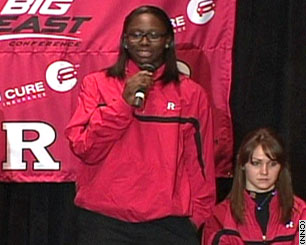
{visual description: Captain Essence Carson of the Rutgers Women's basketball team addresses the audience at the press conference held today.}
Snippets:
Rutgers President : Thank you for being the outstanding ambassadors you are. My heart goes out to each and every one of you.
Coach C. Vivian Stringer:
Let me bring a human face to all of this...I want you to see ten young women who accomplished so much...that we...are so very proud of. These young ladies are valedictorians of their class....future doctors, musical prodigies...girl scouts..the best this nation has to offer and we are so very fortunate to have them here at Rutgers University....young ladies of class, distinction...God's representatives in every sense of the word.
...there are five freshmen...with over a 3.0 GPA...bright ..gifted hardworking. talking about Don Imus story....forgetting what it's ..about....perseverance, hard work...no one believed in them but them. That's the greatest story...I have nothing but pride and respect for them....came back to this..so hurt by the remarks that were uttered by Mr. Imus...we can't let other people steal our joy. ..I was a victim of racial discrimination but I had ...people..who stood up for me..
I would ask...who could hear these comments and not be personally offended? Are women hos? Would you want your daughter to be called that? ...It's about us as a people, black, white, purple or green...the color is green...these aren't political figures...hardworking young women that little girls look up to..bigger issue here...it is all women...have we lost a sense of our own moral fiber?
..i honor and respect their parents who entrust their daughters to me at such a delicate age...so I would ask all of us as adults what is this all about? Are we not responsible...for nurturing their dreams and supporting them? ...What happens when young people do good things and do the right things?..Is there malice in my heart? No, I'm hurt.....despicable words are not right...it's time for everybody to reflect on what's going on..it's been time.
..It took me 25 years to come to a championship game and for once....this was a team that had so little and gave so much...so young.....this was a team that would restore all our faith and confidence in young people. ..we hold our heads with with dignity and ...with respect for ourselves.
Heather Zurich, player:
...we fought, we persevered and most of all we believed in ourselves...but all of our accomplishments were lost, our moment was taken away. We were stripped of this moment by degrading comments made by Mr. Imus..what hurts most is that ...Mr. Imus doesn't know any of us personally...i beleve we present ourselves well... he knows not one of us.
{Each player gets up and introduces herself]
Essence Carson, Captain of team
I would like to express our team's great anger, hurt and disgust...deeply saddened by racial characterization. Imus..brought us to harsh reality ...under brightest lights... has made history...where were these major networks when we ...were making history? ..now we are being bombarded with emails, phone calls..taken a toll on us physically and mentally...we ask that you not recognize us in a light as dim as this....agreed to meeting with Don Imus....private meeting....express our great hurt and sadness this has brought to us...it's about women across the world, across this nation...take a stand..don't look at it as if we're ...attacking {Imus}....we're attacking an issue that we know isn't right.
It isn't right.
As a Rutgers alumna I am proud of these young women and I too am saddened by the fact that the media coverage was not there until the controversy with Imus occurred.
Subscribe to:
Posts (Atom)