Last night during the #chsocm chat, rain began to pour through one of my open windows. I watched as it started to drench my bed, the sheets and blankets looking increasingly unwelcoming.
I know, as a quadriplegic, that trying to close a window is almost physically impossible. Nevertheless, I rolled over and tried to shut the window. Several things happened.
I got wet.
The window came down a tiny bit.
And I began laughing.
I was laughing at myself because I knew closing that window wasn't likely to happen, but there I sat, soaking wet, giving it a shot. It was a good laughter, not the self deprecating kind.
I laughed because it didn't really matter whether that window stayed open or shut. The rain would eventually stop. Everything was already wet. But why not give it a try? Why not use some leverage rather than sitting there thinking "Oh, I can't do that".
Because maybe I can find a way to do it. And it felt good to get that window down just a tiny bit.
The sheets and blankets will dry. My clothes will dry. No damage done.
No reason not to laugh, at myself, at the situation, even at being a quad in a thunder storm with rain pouring in the windows.
I laughed out of a sense of perspective.
It's all in the leverage, in the approach, in the way we try to
do things , sometimes even in the attempt - whether we're quads or not.

Wednesday, May 30, 2012


Monday, May 28, 2012
Memorial Day 2012
From the Make the Connection channel on YouTube, which features stories of veterans, here is a clip from Bobby, who served in the Army and was burned over 40 per cent of his body.
Mike talks about living with the memories of war and how he feels he owes it to those who
didn't come back to live well.
Tessa talks about the difficulties she faces in dealing with civilian friends at times after
her service.
You can see more veterans' stories here.
Mike talks about living with the memories of war and how he feels he owes it to those who
didn't come back to live well.
Tessa talks about the difficulties she faces in dealing with civilian friends at times after
her service.
You can see more veterans' stories here.
Friday, May 25, 2012
NCD Urges Expeditious Senate Approval of the Convention on the Rights of Persons with Disabilities
PRESS
RELEASE
May 25, 2012
May 25, 2012
Today, seven United States
Senators issued a statement of bipartisan support for United States ratification
of the Convention on the Rights of Persons with Disabilities.
“The Convention was undertaken
with the same goals as America had in enacting the ADA: to empower individuals
with disabilities to achieve economic self-sufficiency, independent living, and
inclusion and integration into all aspects of society. While we have fostered
considerable progress through international collaborations, far too many people
with disabilities languish under their countries’ insufficient governmental
frameworks. Ratification of the CRPD will be a huge step forward in enhancing
the lives of people with disabilities around the world,” stated Joan Durocher,
NCD’s General Counsel and Director of Policy.
Ratification of the CRPD will allow U.S.
participation at the CRPD Conference of States Parties and permit the U.S. to
appoint a member of the CRPD Committee. Through these mechanisms, the U.S. can
influence guidance on the implementation of the treaty and lend its expertise as
more countries develop their own disability rights laws.
Marylyn Howe, NCD Board Member,
added, “In both our mandated advisory role and that of promoting policy that
enhances the lives of people with disabilities, the National Council on
Disability (NCD) was pleased to support the efforts of the United States
throughout the development of the Convention.”
By being a signatory to this
historic document, and submitting it to the U.S. Senate for ratification, the
United States provides its clear support for the principles of the Convention.
NCD urges the Senate to expeditiously ratify this historic treaty. Upon
ratification, the United States will join
more than 140 other countries in committing themselves to protecting the rights
of people with disabilities.
The public
announcement of the support for ratification by this bipartisan group of U.S.
Senators can be found here:
About the National Council on
Disability: NCD is a small, independent federal agency comprised of 15
Presidentially-appointed, Senate-confirmed Council Members and a small staff,
who advise the President, Congress and other federal agencies on disability
policy, programs, practices, and procedures.
###
Gary Presley: The View from Down Here
One of my favorite writers, Gary Presley, author of Seven Wheelchairs: A Life beyond Polio, has written a new book of essays, published in e-book form. It is available on Amazon. I encourage you to go buy it.
Why an e-book? He explains:
He writes about the book:
Many of the essays included in The View from Down Here have been published in other venues, but many of those published appear here in their original form, mostly meaning longer than the edited/published versions.
Why an e-book? He explains:
So why now? Why Kindle? Ego, again, but also because I think that
electronic publishing—digital books—will become more prominent as a
medium for transmitting information. If that's the case, I want my
essays in that form together rather than having them scattered
throughout independent and unrelated archives.
He writes about the book:
Many of the essays included in The View from Down Here have been published in other venues, but many of those published appear here in their original form, mostly meaning longer than the edited/published versions.
The View from Down Here has nothing so fancy. It has ten essays about life.
- Cooking for Dogs
- Triptych
- Ruby-throat Fusion
- The Part that Kept Me from Screaming
- In the Wake of the Wind
- You Are What You Eat
- A Pot to Pee in
- Prejudice
- No One Was Coming
- Peter, Paul, and Mary
Wednesday, May 23, 2012
Pedestrian concerns
There are pedestrian concerns, which are matters of little import, and there are pedestrian concerns, which are about real pedestrians, including those on wheels.
Every day I see news stories about people in wheelchairs, people who are blind, people who are deaf and those with other disabilities being hit by cars. The stories are graphic - the photos real. Remains of a power chair lie scattered on a city street. A victim's shoes, bloodied, remain on a crosswalk.
Sometimes the story emphasizes that the pedestrian was violating the law- crossing in the wrong place, for example. It never says whether there was construction going on, or if other obstacles prevented the person from using a crosswalk or if there even was a crosswalk that was clearly delineated and accessible.
I've found as a wheelchair user that I can't assume there are curb cuts that lead to a crosswalk. I can't assume that sidewalks are passable so I sometimes find myself in the street when I don't care to be there at all. Once in a while, I am in a position that if I was hit by a car - and I could be - I would technically be in the wrong , but short of a helicopter descending from the sky and lifting my wheelchair over the obstacle, there is no other way for me to get around.
That's the story that's never written. It may sound like a pedestrian concern, a trivial matter, to some. A lot of these folks have no other way to get around. Why are they on unsafe roads at night? They don't have other transportation. Why are they crossing busy, unsafe intersections? They have to get around and no one has made them safe - even when people have pointed out the issues.
The stories sometimes get told -- of the senior citizen trying to get to the food store which is on a highway, of the disabled person heading toward their medical appointment or social engagement and on and on. Many times, however, only the statistics remain in the story - the time of the accident, who hit who, and often the mistake made by the driver or the victim, which, I suppose, in the end, we all know doesn't change who is most likely to get maimed or killed.
If you asked their families and loved ones of these victims if winding up as road kill was their life plan, I bet they would say no.
If you asked if it was an accident waiting to happen, some would say yes, most of the time.
If you asked if there was any other way for these folks to get around, they would say no, almost all of the time.
Pedestrian concerns on a Wednesday morning, as usual. Lists of accidents, as usual.
Solutions to transportation issues? Not so forthcoming.
Today I will be tweeting stories of pedestrian accidents. As I can . When I can. Join me. Raise awareness.
Every day I see news stories about people in wheelchairs, people who are blind, people who are deaf and those with other disabilities being hit by cars. The stories are graphic - the photos real. Remains of a power chair lie scattered on a city street. A victim's shoes, bloodied, remain on a crosswalk.
Sometimes the story emphasizes that the pedestrian was violating the law- crossing in the wrong place, for example. It never says whether there was construction going on, or if other obstacles prevented the person from using a crosswalk or if there even was a crosswalk that was clearly delineated and accessible.
I've found as a wheelchair user that I can't assume there are curb cuts that lead to a crosswalk. I can't assume that sidewalks are passable so I sometimes find myself in the street when I don't care to be there at all. Once in a while, I am in a position that if I was hit by a car - and I could be - I would technically be in the wrong , but short of a helicopter descending from the sky and lifting my wheelchair over the obstacle, there is no other way for me to get around.
That's the story that's never written. It may sound like a pedestrian concern, a trivial matter, to some. A lot of these folks have no other way to get around. Why are they on unsafe roads at night? They don't have other transportation. Why are they crossing busy, unsafe intersections? They have to get around and no one has made them safe - even when people have pointed out the issues.
The stories sometimes get told -- of the senior citizen trying to get to the food store which is on a highway, of the disabled person heading toward their medical appointment or social engagement and on and on. Many times, however, only the statistics remain in the story - the time of the accident, who hit who, and often the mistake made by the driver or the victim, which, I suppose, in the end, we all know doesn't change who is most likely to get maimed or killed.
If you asked their families and loved ones of these victims if winding up as road kill was their life plan, I bet they would say no.
If you asked if it was an accident waiting to happen, some would say yes, most of the time.
If you asked if there was any other way for these folks to get around, they would say no, almost all of the time.
Pedestrian concerns on a Wednesday morning, as usual. Lists of accidents, as usual.
Solutions to transportation issues? Not so forthcoming.
Today I will be tweeting stories of pedestrian accidents. As I can . When I can. Join me. Raise awareness.
Sunday, May 20, 2012
Tracking Evan
Parents of Evan Moss , who has epilepsy and Tuberous Sclerosis (TSC), create SeizureTracker.com, an online tool for logging seizures and medications.
Wednesday, May 16, 2012
Paralyzed Woman Moves Robotic Arm with Mind

Check this out. A huge smile appears on Cathy Hutchinson's face after she's able to guide the robot arm to bring her a bottle to drink from. She's been unable to move or speak for 15 years- and has been working since 2005 to fine tune this system.
Just awesome.
To read more about it, go here.
Monday, May 14, 2012
Get It Together
This 1976 award winning documentary produced, directed and edited by Rick Miner featuring Rancho Los Amigos recreational therapist Jenn Minnebraker
h/t New Mobility Magazine on Facebook
Friday, May 11, 2012
Review (sort of) for Tetra Mouse
Once upon a time, in a land not so far away, there lived a city full of mice or, as some assistive technology buffs will insist, mouses.
There were all kinds of mouses. Most were used with hands, but others were used in different ways. They were made for people who didn't find it practical to use a mouse with their hands.
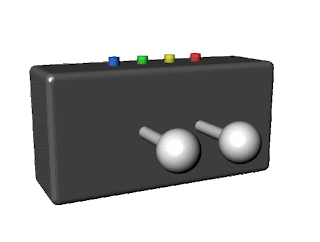
Tetra Mouse was one of those mouses. Tetra Mouse was used by people with their chin, lips or tongue. He was shaped like a small black box, with two white sticks protruding out and knobs at the end of the sticks. The right knob was used to move the cursor, up , down or diagonally. The left knob was used to click, right click, drag and drop and perform other functions like controlling the speed. A series of lights on top of the box sent signals when the function was changed.
Just plugging Tetra Mouse into a computer made him happy - his little lights would go off and he was ready to work. He didn't care if it was night or day outside. He didn't need any software that could crash. No, he was an independent little mouse. There he was, blinking and winking and ready to cover things 24/7. Tetra Mouse happily raced the cursor around the screen, sending off only an occasional click and blinking light, even at 2 a.m. In dawn's early light, he sat waiting, ready to start a new day.
And where did Tetra Mouse hang out when he wasn't working? Right on an articulating arm, ready to go. You see, Tetra Mouse was not only reliable, but loyal. So you would think that Tetra Mouse, with all these wonderful qualities, would be famous. Alas- he was not, but that didn't bother him. To those he helped, he knew he was - well - a hero.
Almost as much a hero as another mouse, but we'll leave that story for another day.

There were all kinds of mouses. Most were used with hands, but others were used in different ways. They were made for people who didn't find it practical to use a mouse with their hands.
Tetra Mouse was one of those mouses. Tetra Mouse was used by people with their chin, lips or tongue. He was shaped like a small black box, with two white sticks protruding out and knobs at the end of the sticks. The right knob was used to move the cursor, up , down or diagonally. The left knob was used to click, right click, drag and drop and perform other functions like controlling the speed. A series of lights on top of the box sent signals when the function was changed.

Just plugging Tetra Mouse into a computer made him happy - his little lights would go off and he was ready to work. He didn't care if it was night or day outside. He didn't need any software that could crash. No, he was an independent little mouse. There he was, blinking and winking and ready to cover things 24/7. Tetra Mouse happily raced the cursor around the screen, sending off only an occasional click and blinking light, even at 2 a.m. In dawn's early light, he sat waiting, ready to start a new day.
And where did Tetra Mouse hang out when he wasn't working? Right on an articulating arm, ready to go. You see, Tetra Mouse was not only reliable, but loyal. So you would think that Tetra Mouse, with all these wonderful qualities, would be famous. Alas- he was not, but that didn't bother him. To those he helped, he knew he was - well - a hero.
Almost as much a hero as another mouse, but we'll leave that story for another day.
Wednesday, May 9, 2012
Wired - not!
I've added a new piece of adaptive equipment to my computer set-up - a tetra mouse. *
Basically, it's a way to move the mouse around the screen. It clicks, drags and drops and allows me a lot more options than relying on just voice recognition. One of the reasons I chose it is because it's simple, easy and a durable way to get things accomplished.
I've only had it a few days, but already I've been able to go places, as they say, where everyone else already goes. That is, I no longer avoid actually reading articles on sites because navigating the page is so difficult. I can move around at will, which is an odd feeling after spending so much time planning ahead to avoid moving a cursor.
Do I really need to go there? I would think. Is there an aggregator, a short cut? Of course I found workarounds, but in the process I missed the freedom of going where I wanted to.
I personally dislike wires. I have a cordless headphone for my dictation and the tetra mouse doesn't have to be worn. It sits in front of me on an articulating arm (much like that used for cameras). If I want to use it, I do. If not, it's independent and doesn't need me to hold, coddle or otherwise engage with it. I like that in devices. At night I move it out of the way and tuck it in, so to speak, safely.
So my system leaves me free to roam around, unencumbered by wires and not having to worry if something is left on or running juice. Freedom. It allows me to think about what I'm writing, rather than to think about the technology!
*I'll be doing a review of the tetra mouse as soon as I've used it a bit longer.
Basically, it's a way to move the mouse around the screen. It clicks, drags and drops and allows me a lot more options than relying on just voice recognition. One of the reasons I chose it is because it's simple, easy and a durable way to get things accomplished.
I've only had it a few days, but already I've been able to go places, as they say, where everyone else already goes. That is, I no longer avoid actually reading articles on sites because navigating the page is so difficult. I can move around at will, which is an odd feeling after spending so much time planning ahead to avoid moving a cursor.
Do I really need to go there? I would think. Is there an aggregator, a short cut? Of course I found workarounds, but in the process I missed the freedom of going where I wanted to.
I personally dislike wires. I have a cordless headphone for my dictation and the tetra mouse doesn't have to be worn. It sits in front of me on an articulating arm (much like that used for cameras). If I want to use it, I do. If not, it's independent and doesn't need me to hold, coddle or otherwise engage with it. I like that in devices. At night I move it out of the way and tuck it in, so to speak, safely.
So my system leaves me free to roam around, unencumbered by wires and not having to worry if something is left on or running juice. Freedom. It allows me to think about what I'm writing, rather than to think about the technology!
*I'll be doing a review of the tetra mouse as soon as I've used it a bit longer.
Tuesday, May 8, 2012
"The" Piano Man
Even Billy Joel is impressed with six year old Ethan Walmark's rendition of Piano Man.
Ethan, who has autism, can be seen playing other songs at this link.
Ethan, who has autism, can be seen playing other songs at this link.
NY Times editorial : Monitoring Care for the Disabled
The lack of monitoring or prosecution of those involved in deaths or abuse of disabled residents in homes for the disabled is addressed in a NY Times editorial. In the last decade, over 1200 deaths attributed to unnatural or unknown causes have occurred, in addition to instances of abuse, in publicly financed homes for the disabled.
The editorial supports new legislation proposed by Governor Cuomo. The legislative package would create a new agency to oversee these homes, a code of ethical conduct for workers, a hot line to report abuse and an increase in criminal penalties for endangering the lives of the disabled. It would also expand the state's Freedom of Information Act to require private facilities with state licenses to make public information about abuse or neglect.
The editorial supports new legislation proposed by Governor Cuomo. The legislative package would create a new agency to oversee these homes, a code of ethical conduct for workers, a hot line to report abuse and an increase in criminal penalties for endangering the lives of the disabled. It would also expand the state's Freedom of Information Act to require private facilities with state licenses to make public information about abuse or neglect.
Sunday, May 6, 2012
Disability Expo 2012
Was able to visit the Disability Expo yesterday in Edison NJ. Found a lot of new vendors and items since I was there several years ago. I haven't tried these products and didn't get samples/demos, so I can't vouch for them, but it'll give you an idea of a few I found interesting for readers.
Cell handle This is a one finger or thumb holder that attaches to a cell phone, iPod touch or other small gadget. This appeared to be quite durable and the vendor told me the system was tested to safely hold up to nine pounds which far exceeds the weight of any gadget.
e-Handle is a larger velcro holder that extends over your hand for an e - reader
EZ Cell Holder - this is a fairly affordable product with universal design features to hold gadgets of all kinds via a velcro system . Base pads can be placed where you charge your phone, on a car dashboard, wall, PC monitor, kitchen cabinet, etc.
scottpaultech.com
 HDS Medallion - wheelchair bags, ladies! These make great gifts. I fell in love with a paisley pink bag that was irresistible but I resisted! Very pretty and versatile bags which appear to be well made in fashionable designs with adjustable length straps for walkers, wheelchairs, medical scooters and power chairs or as a shoulder bag. order at hdsmedallion.com If you order certain bags like the Espresso Flower Shower shown above (permission obtained to use image) , the company donates $7 to the Christopher and Dana Reeve Foundation
Backbones - an organization providing mentors for newly injured spinal cord folks , nationally based
backbonesonline.com
Indoor Rower by Concept 2 - tried this out with my quaddy hands in cuffs and was amazed at how relatively inexpensive this item is compared to other exercise items I've seen. (The seat would need modifications for those without good trunk control and paralysis or other conditions). concept2.com 800-245-5676
Riding with Heart Hunterdon Equine Assisted Recreation and Therapy offers numerous kinds of programs for those with disabilities and/or working through life issues. The program
offers equine assisted learning, equine assisted psychotherapy, Mommy & Me, Special Olympics equestrian team, autism social skills group, therapeutic riding lessons and an inclusive summer camp experience , certified PATH Intl therapeutic riding instructors and properly credentialed therapists , for those with autism, ADD, Downs syndrome, cerebral palsy, spina bifida, Developmental delays, spinal cord injuries, and depression and bereavement . This video explains the program more
This nonprofit truly deserves support if anyone out there can do that!
ridingwithheart.org
HomeFreeHome - volunteer architects who design barrier-free homes for free or low cost based on income qualifications for those with permanent physical disabilities that restrict daily living activities.
homefreehome.org 516-883-0403
Cell handle This is a one finger or thumb holder that attaches to a cell phone, iPod touch or other small gadget. This appeared to be quite durable and the vendor told me the system was tested to safely hold up to nine pounds which far exceeds the weight of any gadget.
e-Handle is a larger velcro holder that extends over your hand for an e - reader
EZ Cell Holder - this is a fairly affordable product with universal design features to hold gadgets of all kinds via a velcro system . Base pads can be placed where you charge your phone, on a car dashboard, wall, PC monitor, kitchen cabinet, etc.
scottpaultech.com
Backbones - an organization providing mentors for newly injured spinal cord folks , nationally based
backbonesonline.com
Indoor Rower by Concept 2 - tried this out with my quaddy hands in cuffs and was amazed at how relatively inexpensive this item is compared to other exercise items I've seen. (The seat would need modifications for those without good trunk control and paralysis or other conditions). concept2.com 800-245-5676
Riding with Heart Hunterdon Equine Assisted Recreation and Therapy offers numerous kinds of programs for those with disabilities and/or working through life issues. The program
offers equine assisted learning, equine assisted psychotherapy, Mommy & Me, Special Olympics equestrian team, autism social skills group, therapeutic riding lessons and an inclusive summer camp experience , certified PATH Intl therapeutic riding instructors and properly credentialed therapists , for those with autism, ADD, Downs syndrome, cerebral palsy, spina bifida, Developmental delays, spinal cord injuries, and depression and bereavement . This video explains the program more
This nonprofit truly deserves support if anyone out there can do that!
ridingwithheart.org
HomeFreeHome - volunteer architects who design barrier-free homes for free or low cost based on income qualifications for those with permanent physical disabilities that restrict daily living activities.
homefreehome.org 516-883-0403
Thursday, May 3, 2012
Inclusion Series Webinar #4: Social Inclusion in Faith Communities
Inclusion Series Webinar #4:
Social Inclusion in Faith Communities
Here is the
event page on our website which you can direct people to which includes a
registration link, overview, and speaker bios: http://www.aaidd.org/content_7587.cfm
Overview:
Although the AAIDD has a compelling position statement
addressing the importance of supporting well the spirituality and religious
participation of people with disabilities intellectual or developmental
disabilities, many faith communities are uncertain about how to welcome people
with disabilities and their families well into the life of their congregation.
This webinar will focus on policies and practices for supporting people with
intellectual and developmental disabilities to participate and contribute in
meaningful ways within the faith community of their choice. Erik and Bill will
share best practices for supporting clergy, congregations, and service
providers to move towards inclusive faith supports. New resources and
initiatives will be also be shared.
Presenters:
Presenters:
Dr. Erik Carter, Vanderbilt University
Erik Carter is an Associate Professor in the Department of
Special Education at Vanderbilt University. He completed his graduate work in
the area of severe disabilities at Vanderbilt University and his undergraduate
work at Wheaton College. His research and teaching focuses on strategies for
supporting meaningful school inclusion and promoting valued roles in school,
work, and community settings for children and adults with intellectual and
developmental disabilities. He has co-authored four books, one of which is
Including People with Disabilities in Faith Communities: A Guide for
Service
William Gaventa, UMDNJ-Robert Wood Johnson Medical
School
Bill Gaventa serves as Director of Community and
Congregational Supports at the Elizabeth M. Boggs Center on Developmental
Disabilities, and Associate Professor, Robert Wood Johnson Medical School,
UMDNJ. In his role at The Boggs Center, Bill works on community supports,
training for community services staff, spiritual supports, training of
seminarians and clergy, aging and end of life/grief issues, and cultural
competence. Information and resources from these projects can be found on The Boggs Center website. He has
been a frequent speaker, trainer, and workshop leader in these areas. As a
writer and editor, he has edited newsletters and several book, written articles
and chapters, and served as the Editor of the Journal of Religion, Disability
and Health for 14 years, now as an Associate Editor. Bill has a wife, Beverly
Roberts Gaventa, a Professor of New Testament at Princeton Theological Seminary,
and a son and daughter-in-law and a new grandson.
Subscribe to:
Posts (Atom)