Nothing like stating the obvious, but I find trying to deal with kleenex one of the hardest things to do with my paralyzed arm and dexterity issues when I get a cold. When reaching up to blow your nose is problematic, I've had to learn to let gravity help in other ways.
A roll of toilet paper poised over my head and shoulder could be a solution, although there's no marketable device for it yet. Stringing a roll over something that looks like an IV stand on a base would work. Problem is with an active cat around, chances are the toilet paper would wind up around the room.
Then there's the side angle method, where laying down so my nose is level is helpful. That way I don't have to reach up to my face. That doesn't eliminate the problem with holding onto the kleenex though. And they don't make Kleenex on a String. Yet.
And this guy would totally disapprove of the ways I go about blowing my nose. He's got some tips about how to clear one nostril at a time, etc. but says nothing that's useful to someone with quadriplegia. Oh well.

Saturday, January 31, 2009


Friday, January 30, 2009
NH Legislature proposed redefinition of terminally ill
Over at Not Dead Yet, a post about a proposed change of language in assisted suicide- redefining terminally ill to terminal conditions- a change due to be discussed next week.
From the Not Dead Yet site:
A link to HB 304 - AN ACT relative to death with dignity for certain persons suffering from a terminal condition.
Definition of "terminal condition":
XIII. “Terminal condition” means an incurable and irreversible condition, for the end stage of which there is no known treatment which will alter its course to death, and which, in the opinion of the attending physician and consulting physician competent in that disease category, will result in premature death.
Read that definition carefully, terminality is defined as having a condition that is irreversible and will result in a premature death. My partner would fit that definition. Many people I work with also fit the definition.
None of them are dying.
For more, click on the above link.
From the Not Dead Yet site:
A link to HB 304 - AN ACT relative to death with dignity for certain persons suffering from a terminal condition.
Definition of "terminal condition":
XIII. “Terminal condition” means an incurable and irreversible condition, for the end stage of which there is no known treatment which will alter its course to death, and which, in the opinion of the attending physician and consulting physician competent in that disease category, will result in premature death.
Read that definition carefully, terminality is defined as having a condition that is irreversible and will result in a premature death. My partner would fit that definition. Many people I work with also fit the definition.
None of them are dying.
For more, click on the above link.
Just a video today...
plowing through work, so here's a winter-themed video of a sledding cat from CNN and thinking of my Ski for Light friends, hoping they're having fun in the snow!
and a poem:
Winter - such
A parochial touch
A cup of tea, a shovel
Suburban white so icy bright
A snowball, a fall, a cuddle.
and a poem:
Winter - such
A parochial touch
A cup of tea, a shovel
Suburban white so icy bright
A snowball, a fall, a cuddle.
Thursday, January 29, 2009
One point, one more win to get to 1000
The Lady Vols won against Ole Miss tonight by one point, making it the 999th win for coach Pat Summitt. I was working and didn't hear or see the game, but there was a different starting line. Angie Bjorkland scored the winning point in the final seconds. The Associated Press reports:
The Lady Rebels nearly grabbed their first win over the Lady Vols since a 78-72 victory on Feb. 4, 1996 at Oxford. Mississippi has not beaten Tennessee in Knoxville since a 69-65 decision on Jan. 31, 1987.
Rising to her own level
One more win to get to 1000. The Lady Vols play Monday night on ESPN against Oklahoma.
The Lady Rebels nearly grabbed their first win over the Lady Vols since a 78-72 victory on Feb. 4, 1996 at Oxford. Mississippi has not beaten Tennessee in Knoxville since a 69-65 decision on Jan. 31, 1987.
Tennessee could have taken control of the game with free throws, but after entering the game shooting 68.6 percent from the line, the Lady Vols hit 16 of 31 for 51.6 percent.
Frustrated with her team falling behind in games, Summitt drilled her team through intense practices this week.
On the subject of Coach Summitt, I found a great article.
Rising to her own level
One more win to get to 1000. The Lady Vols play Monday night on ESPN against Oklahoma.
Wednesday, January 28, 2009
Growing field, low pay
What am I talking about? Home health care.
A NY Times editorial directs attention to the fact that caregivers for the elderly (and people with disabilities) lack protection on their jobs for minimum wages and overtime pay, although the demand increases as America ages. They also do not receive health care benefits in many areas. No federal law protects those who do home care.
Despite the moral issues involved ( via the article: It is unconscionable that workers who are entrusted with the care of some of the nation’s most vulnerable citizens are themselves unprotected by basic labor standards.), the article states it is also unwise:
...because poor pay for long hours leads to high turnover, which undermines the quality of care. Turnover also drives up the cost of providing home care — a needless drain on Medicaid, which pays for many home care services. And that is not the only way that poor quality home care jobs end up costing taxpayers. Nearly half of home care workers rely on food stamps or other public assistance, so taxpayers ultimately compensate for their low pay and inadequate benefits.
I am ever grateful to Meredith, who continues to assist me despite these issues and is right now coming over in the snow. But I have gone without help due to the high turnover, low wages and other issues involved in the past which was a hellish way to live.
I join in the point of view of this editorial, hoping that federal protections are granted to home care workers as our government works toward creating jobs for the future and that those doing these jobs receive fair wages and benefits commensurate with their dedication.
A NY Times editorial directs attention to the fact that caregivers for the elderly (and people with disabilities) lack protection on their jobs for minimum wages and overtime pay, although the demand increases as America ages. They also do not receive health care benefits in many areas. No federal law protects those who do home care.
Despite the moral issues involved ( via the article: It is unconscionable that workers who are entrusted with the care of some of the nation’s most vulnerable citizens are themselves unprotected by basic labor standards.), the article states it is also unwise:
...because poor pay for long hours leads to high turnover, which undermines the quality of care. Turnover also drives up the cost of providing home care — a needless drain on Medicaid, which pays for many home care services. And that is not the only way that poor quality home care jobs end up costing taxpayers. Nearly half of home care workers rely on food stamps or other public assistance, so taxpayers ultimately compensate for their low pay and inadequate benefits.
I am ever grateful to Meredith, who continues to assist me despite these issues and is right now coming over in the snow. But I have gone without help due to the high turnover, low wages and other issues involved in the past which was a hellish way to live.
I join in the point of view of this editorial, hoping that federal protections are granted to home care workers as our government works toward creating jobs for the future and that those doing these jobs receive fair wages and benefits commensurate with their dedication.
Tuesday, January 27, 2009
A handicap parking experiment
In this March 2008 video filmed by ABC, actors set up a situation where two young women steal a handicap parking spot to see how passerbys react.
In some of the scenes, an actor with a disability appears, asking them to move so she can use the spot, while in others, the two young women are shown getting out of their convertible car, testing out tennis rackets to see if any passerbys will tell them not to use the spot.
****
The video below shows how trucks blocking handicap parking spots also present a problem.
In some of the scenes, an actor with a disability appears, asking them to move so she can use the spot, while in others, the two young women are shown getting out of their convertible car, testing out tennis rackets to see if any passerbys will tell them not to use the spot.
****
The video below shows how trucks blocking handicap parking spots also present a problem.
Nanotubes may be used to treat Alzheimer's and Parkinson's disease
Special Nanotubes May Be Used as a Vehicle for Treating Neurodegenerative Disorders
(PhysOrg.com) -- Electrical engineering researchers at the University of Arkansas have demonstrated that magnetic nanotubes combined with nerve growth factor can enable specific cells to differentiate into neurons. The results from in vitro studies show that magnetic nanotubes may be exploited to treat neurodegenerative disorders such as Parkinson’s disease and Alzheimer’s disease because they can be used as a delivery vehicle for nerve growth factor.
Beta Internet Explorer 8 is out
IE 8 beta is now released for the public.
[It] offers performance upgrades to speed up page loading, new navigation features and tab isolation so that if you hit a bad site only that tab closes and not the whole browser.
This version will not run on Windows 7. Users will have to wait until the final version for that.
See also More Details about IE8
For an easy walkthrough, listen to the video below.
[It] offers performance upgrades to speed up page loading, new navigation features and tab isolation so that if you hit a bad site only that tab closes and not the whole browser.
WebSlices will give users a way to keep updated about a particular item on a web page like stock prices, the weather or an eBay auction.
Accelerators let users access Web services like maps or translations in a small window without having to leave the page. via news.bbc.co.uk
This version will not run on Windows 7. Users will have to wait until the final version for that.
See also More Details about IE8
For an easy walkthrough, listen to the video below.
Monday, January 26, 2009
The Lady Vols really lose to Auburn
I watched the Lady Vols play Auburn yesterday on ESPN 360, hoping to see coach Pat Summitt win her 999th game. [Update: see Summitt's trek at Tennessee nears pinnacle]
Instead I saw them lose in a lackluster effort.
I know that the team is young and there have been injuries, so let's just get that out of the way first.
But, ladies, really. The first half wasn't that bad, although they didn't even get to the free throw line. There were three travel violations within as many minutes, it seemed, but at least the Lady Vols hung in there. But in the second half of the game it looked to me as if the team gave up. As the Auburn team scored point after point, some of the Lady Vol players just didn't respond.
When I used to see that in wheelchair tennis, I always thought it was either a conditioning problem or a player had given up, just decided that a loss was inevitable, and stopped trying to win. I find it hard to believe that a team coached by Pat Summitt has conditioning issues, which leads me to think that some of the players gave up. It certainly looked that way.
This is a far more serious issue for a coach to deal with than the fact that she has a young team. Players can get experience as they play, but a negative attitude on a team has to be rooted out.
I don't get to see the team play that often, because so many of their games aren't televised up here and I listen to them on their website via their radio broadcast. But I'm guessing by the time I do see them again, knowing Pat Summitt, I may be looking at different faces. Although at least one player, the one who scored 26 points, understood.
"They got all the hustle plays and they just looked like they wanted it more than we did," Stricklen said. "The turnovers really hurt us. That's really what killed us in the game. We could see they had a lot of effort. They were in the passing lanes. They were just stealing the ball."
This loss was worse than the score reflected. And kud0s to the Auburn team for their win.
[Update:
Summitt: I've lost my patience :
We've got some non-competitive people on this team and that's not going to get it. They're not going to play," she said. She's tweaking her lineup for when No. 13 Tennessee (15-4, 4-3 Southeastern Conference) hosts Mississippi (13-6, 2-3) on Thursday night. ]
Instead I saw them lose in a lackluster effort.
I know that the team is young and there have been injuries, so let's just get that out of the way first.
But, ladies, really. The first half wasn't that bad, although they didn't even get to the free throw line. There were three travel violations within as many minutes, it seemed, but at least the Lady Vols hung in there. But in the second half of the game it looked to me as if the team gave up. As the Auburn team scored point after point, some of the Lady Vol players just didn't respond.
When I used to see that in wheelchair tennis, I always thought it was either a conditioning problem or a player had given up, just decided that a loss was inevitable, and stopped trying to win. I find it hard to believe that a team coached by Pat Summitt has conditioning issues, which leads me to think that some of the players gave up. It certainly looked that way.
This is a far more serious issue for a coach to deal with than the fact that she has a young team. Players can get experience as they play, but a negative attitude on a team has to be rooted out.
I don't get to see the team play that often, because so many of their games aren't televised up here and I listen to them on their website via their radio broadcast. But I'm guessing by the time I do see them again, knowing Pat Summitt, I may be looking at different faces. Although at least one player, the one who scored 26 points, understood.
"They got all the hustle plays and they just looked like they wanted it more than we did," Stricklen said. "The turnovers really hurt us. That's really what killed us in the game. We could see they had a lot of effort. They were in the passing lanes. They were just stealing the ball."
This loss was worse than the score reflected. And kud0s to the Auburn team for their win.
[Update:
Summitt: I've lost my patience :
We've got some non-competitive people on this team and that's not going to get it. They're not going to play," she said. She's tweaking her lineup for when No. 13 Tennessee (15-4, 4-3 Southeastern Conference) hosts Mississippi (13-6, 2-3) on Thursday night. ]
Sunday, January 25, 2009
Where is our moral compass: nursing home abuse
I was reading about the case of teenagers who are being charged with abusing elderly nursing home patients under their care. Two of the teens were arraigned on Thursday and the newspaper dubbed them "mean girls". I am disturbed by the headline because it inappropriately sensationalizes the story.
Brianna Broitzman, 19, and Ashton Larson, 19, reportedly spit at, poked and rubbed the genitals of at least seven residents at the Good Samaritan Society nursing home in Albert Lea, Minn., according to a criminal complaint filed in December and obtained by ABCNews.com.
And there's more - more teens involved, some of whom failed to report the incidents. Allegations of patting of a patient's buttocks, spanking a patient with a cane on the buttocks, lying in bed with a patient and inserting a finger into a patient's rectum, poking a patient in the breasts and taking videos and pictures of patients.
The abuse allegedly went on between January and May 2008 and happened to patients with Alzheimers and dementia, a vulnerable population that can't even speak up. If they do, people assume they are imagining what is seen as a bizarre story.
The case is also being called an "abuse for thrills" case, continuing the theme that this is more about those who abused, than those who were abused. It is as if our desire to understand the "why it happened" exceeds our interest in looking at ways to prevent it again. There is no information in the article about any changes made in the level of supervision of nursing assistants who work with such a vulnerable population at this nursing home or any other.
The director of the nursing home is quoted as saying
"Our hearts are in the right place. We're moving forward. Our heads are held up high."
Not so fast. Let's rewind the tape here. It's time for society, for all of us, to own our accountability when the most vulnerable among us are treated this way, especially when we fail to enact change so it doesn't happen again.
Prosecutors say that those charged put their fingers in residents’ mouths and noses to quiet their cries and screams, hit and rubbed their breasts and genitals, and sexually “humped” some residents. The aides allegedly called the abuse “work fun or to get a good laugh.”
This story is not just about those who are being tried for these allegations. It is about those in nursing homes and institutions who remain vulnerable. We need to ask the tough questions here before we move on. In order to do that, we need to get past "mean girls" headlines. We need to figure out why there is more supervision and accountability in jobs at Best Buys and McDonald's, where if an employee walked up to a customer and violated boundaries like this, the police would be called and there might be a store camera filming it too. But that's different, some might say. It's a public place.
Exactly. Which is why there need to be more protections in place for those who are isolated and away from the public view. For those who may not even be able to speak. We need a higher level of accountability and transparency when dealing with caregivers of vulnerable populations, not a lower one.
The question asked by a watchdog group "Where is the moral compass of these employees?" needs to become where is our society's moral compass? What importance do we, as a society, give to the care of those who are most vulnerable? Is their safety our responsibility and, if so, how do we provide ways and means to ensure that? Is their dignity important to us? Is their well being our responsibility?
And, if we answer yes (and I hope we do), what can we do? Can the fact that our government monies go toward paying for this care be used to set in place better protection and advocacy for patients and their families? Shouldn't we scrutinize the level of supervision set in place? Should we have cameras in institutions for better oversight and accountability?
These questions aren't easy ones. But let's not move on until we at least ask them.
Brianna Broitzman, 19, and Ashton Larson, 19, reportedly spit at, poked and rubbed the genitals of at least seven residents at the Good Samaritan Society nursing home in Albert Lea, Minn., according to a criminal complaint filed in December and obtained by ABCNews.com.
And there's more - more teens involved, some of whom failed to report the incidents. Allegations of patting of a patient's buttocks, spanking a patient with a cane on the buttocks, lying in bed with a patient and inserting a finger into a patient's rectum, poking a patient in the breasts and taking videos and pictures of patients.
The abuse allegedly went on between January and May 2008 and happened to patients with Alzheimers and dementia, a vulnerable population that can't even speak up. If they do, people assume they are imagining what is seen as a bizarre story.
The case is also being called an "abuse for thrills" case, continuing the theme that this is more about those who abused, than those who were abused. It is as if our desire to understand the "why it happened" exceeds our interest in looking at ways to prevent it again. There is no information in the article about any changes made in the level of supervision of nursing assistants who work with such a vulnerable population at this nursing home or any other.
The director of the nursing home is quoted as saying
"Our hearts are in the right place. We're moving forward. Our heads are held up high."
Not so fast. Let's rewind the tape here. It's time for society, for all of us, to own our accountability when the most vulnerable among us are treated this way, especially when we fail to enact change so it doesn't happen again.
Prosecutors say that those charged put their fingers in residents’ mouths and noses to quiet their cries and screams, hit and rubbed their breasts and genitals, and sexually “humped” some residents. The aides allegedly called the abuse “work fun or to get a good laugh.”
This story is not just about those who are being tried for these allegations. It is about those in nursing homes and institutions who remain vulnerable. We need to ask the tough questions here before we move on. In order to do that, we need to get past "mean girls" headlines. We need to figure out why there is more supervision and accountability in jobs at Best Buys and McDonald's, where if an employee walked up to a customer and violated boundaries like this, the police would be called and there might be a store camera filming it too. But that's different, some might say. It's a public place.
Exactly. Which is why there need to be more protections in place for those who are isolated and away from the public view. For those who may not even be able to speak. We need a higher level of accountability and transparency when dealing with caregivers of vulnerable populations, not a lower one.
The question asked by a watchdog group "Where is the moral compass of these employees?" needs to become where is our society's moral compass? What importance do we, as a society, give to the care of those who are most vulnerable? Is their safety our responsibility and, if so, how do we provide ways and means to ensure that? Is their dignity important to us? Is their well being our responsibility?
And, if we answer yes (and I hope we do), what can we do? Can the fact that our government monies go toward paying for this care be used to set in place better protection and advocacy for patients and their families? Shouldn't we scrutinize the level of supervision set in place? Should we have cameras in institutions for better oversight and accountability?
These questions aren't easy ones. But let's not move on until we at least ask them.
Saturday, January 24, 2009
Women's basketball coach Kay Yow dies

"Almost everybody is dealing with something," Yow said in a 2006 interview. "We're all faced with a lot of tough issues that we're dealing with.
We know we need to just come to the court and let that be our catharsis in a way. You can't bring it on the court with you, but we can all just think of basketball as an escape for a few hours." - Kay Yow
NC women's basketball coach Kay Yow passed away this morning after battling breast cancer since 1987. She was a tireless fundraiser and continued to coach until recently. She relied on her faith.
Yow won more than 700 games in a career filled with milestones. She coached the U.S. Olympic team to a gold medal in 1988, won four Atlantic Coast Conference tournament championships, earned 20 NCAA tournament bids and reached the Final Four in 1998.
She also was inducted into the Naismith Hall of Fame in 2002, while the school dedicated "Kay Yow Court" in Reynolds Coliseum in 2007.
Pat Summitt's comments on the death of longtime friend Kay Yow
Rutgers coach C. Vivian Stringer "deeply saddened" by death of coaching pioneer Kay Yow
What Others Are Saying in Tribute to Yow
[image description: Kay Yow is shown coaching from the sidelines, her right arm up in the air.]
Medicaid change would encourage putting spouse into nursing home
According to this New York Times article. a change in Medicaid law by outgoing President Bush has been delayed until March by Governor Paterson, in hope that President Obama will overrule it.
For 20 years, federal law has protected married couples from having to choose between divorcing or becoming impoverished when one spouse needs expensive nursing home care, allowing the healthier spouse to retain assets and income while the sicker one’s care is covered by Medicaid.
New York has extended this same rule to couples where one requires at home care.
Now, the federal government has ruled that New York has been too generous in applying the income protections to people at home, forcing several thousand couples to make a stark choice by March.
Advocates say the number of couples affected is close to 4,000.
For 20 years, federal law has protected married couples from having to choose between divorcing or becoming impoverished when one spouse needs expensive nursing home care, allowing the healthier spouse to retain assets and income while the sicker one’s care is covered by Medicaid.
New York has extended this same rule to couples where one requires at home care.
Now, the federal government has ruled that New York has been too generous in applying the income protections to people at home, forcing several thousand couples to make a stark choice by March.
Advocates say the number of couples affected is close to 4,000.
The advocates say that the federal interpretation makes little sense.
“The root of their interpretation is that Congress wanted to give states the option of extending these protections, but only to those whose incomes are so low that they would have no income to share with their spouse,” Ms. Bogart said. “It would be so absurd that no one would ever qualify.So help me God
An interesting blog post on President Obama retaking the oath over at PrawfsBlog:
Most people (myself included) argue that because the transposition did not change meaning, just as adding "so help me God" does not change meaning, the Constitution was not violated by the oath at the Inauguration. But Paulsen argues that it did violate the Constitution (because the focus is purely on the text and the way the oath always is inconsistent with the text); in fact, every President since Washington has, formally, violated the Constitution by adding "SHMG" and their names. But, because meaning has not changed, the unconstitutionality (the "constitutional error," if you will) is harmless; it does not matter and does not require any remedy.
So in asking whether transposing "faithfully" renders the oath invalid, the question is not whether the oath was unconstitutional; it was unconstitutional, as has every other oath since 1789. The question is whether the unconstitutionality matters.
IMHO a lot less harm done at the oath taking by presidents than afterwards.
But this is leading to something - an organization called the So Help Me God project, which is also known as Operation Thank You.

Our latest project is Operation Thank You, a massive effort to collect and send 1 million military thank you cards and get well cards to our troops!
The site offers resources to military members and families and an online store which carries specialty bibles for armed forces members, police and firemen, DVD's, dogtags, and grief packets, among other items. You can visit them here.
{Their logo is shown at left, which shows a silhouette of a person in blue taking an oath and an American flag in the background. On top are the words So Help Me God Project and Beneath SoHelpMeGod.Org on a white background.}
Most people (myself included) argue that because the transposition did not change meaning, just as adding "so help me God" does not change meaning, the Constitution was not violated by the oath at the Inauguration. But Paulsen argues that it did violate the Constitution (because the focus is purely on the text and the way the oath always is inconsistent with the text); in fact, every President since Washington has, formally, violated the Constitution by adding "SHMG" and their names. But, because meaning has not changed, the unconstitutionality (the "constitutional error," if you will) is harmless; it does not matter and does not require any remedy.
So in asking whether transposing "faithfully" renders the oath invalid, the question is not whether the oath was unconstitutional; it was unconstitutional, as has every other oath since 1789. The question is whether the unconstitutionality matters.
IMHO a lot less harm done at the oath taking by presidents than afterwards.
But this is leading to something - an organization called the So Help Me God project, which is also known as Operation Thank You.
Our latest project is Operation Thank You, a massive effort to collect and send 1 million military thank you cards and get well cards to our troops!
The site offers resources to military members and families and an online store which carries specialty bibles for armed forces members, police and firemen, DVD's, dogtags, and grief packets, among other items. You can visit them here.
{Their logo is shown at left, which shows a silhouette of a person in blue taking an oath and an American flag in the background. On top are the words So Help Me God Project and Beneath SoHelpMeGod.Org on a white background.}
The Pope YouTubes, talks about Facebook
With an audience of 1.4 billion, the Vatican now has a channel on YouTube, via which relevant events and activities of the Pope will be broadcast.
This article notes that the Pope joins both President Obama and Queen Elizabeth who have their own channels.
The Pope also spoke recently about Facebook and social networking sites, urging a culture of online respect in his annual message on Communications.
h/t to my sister, Sue
This article notes that the Pope joins both President Obama and Queen Elizabeth who have their own channels.
The Pope also spoke recently about Facebook and social networking sites, urging a culture of online respect in his annual message on Communications.
h/t to my sister, Sue
Friday, January 23, 2009
Denial of home care services to woman with ALS
Ballestexistenz and Reunify Gally are posting about Minna, who has ALS and is being denied services by an agency. Minna says it's because she complained that nurses were not following her doctor's orders. She was on a prolonged hunger strike, although she has started eating again, but is still being neglected.
Minna Mettinen- Kekalainen, 42, has fought for years to keep amyotrophic lateral sclerosis (ALS) from preventing her from doing the things she loves -- skydiving, rowing and raising two children.
But she no longer has it in her to fight a provincial organization she says is refusing to help her when she is at her weakest.
Mettinen-Kekalainen is alone, bedridden or confined to a wheelchair, unable to change her adult diapers or bathe herself, and in constant pain.
Her only source of nutrition is the feeding tube in her stomach, but she is refusing to let friends administer the four cans of supplement she should be receiving daily. via thesudburystar.com
Andrea has appealed for help over at Reunify Gally and listed ways you can help.
The agency is not releasing information, citing confidentiality reasons.
Mettinen-Kekalainen told The Sudbury Star last week she threatened to report the nurses to the Ontario College of Nurses because they were not giving her the care her doctor ordered.
She and friend Jason Bushie say the nursing agency and the Community Care Access Centre have deemed that harassing behaviour.
The truth in the dispute may never be known. What is evident is that Mettinen-Kekalainen seems destined to spend her last days in living conditions that would be considered unfit if a dog were subjected to them.
A contest and an agenda about people with disabilities
Across my desk this morning is a bit of everything, including the Commonweal article by Douglas Kmiec about the election and the blogosphere, in which he discusses the reaction of the Catholic blogosphere to his support of Obama. He writes:
A longtime Republican who served in the Reagan administration, I nonetheless endorsed Obama last spring. Ever since, I’ve been subjected to unrelenting personal attacks launched from right-wing Catholic keyboards-blogs (and bloggers) so coarse and uncivil they make the insults of talk radio sound like actual journalism. Further, the lack of civility that rules the right-wing Catholic blogosphere has infected mainstream Catholic journalism as well. In a syndicated assessment of the 2008 election, one usually thoughtful conservative columnist employed the following descriptions of Catholic Obama supporters: “decadent,” “tribal,” “immoral,” “certainly stupid,” “mindless,” and in need of basic “adult education.” And those were all in a single paragraph! Such highly concentrated rhetorical venom is not calculated to invite discussion.
My support of Obama led to the loss of almost half my Catholic blog links at one point. 54% of Catholics voted for Obama, by the way.
Speaking of Obama, his agenda for people with disabilities is now up over at the White House site. Bill Peace writes about it here in Day One Agenda: Obama Hits a Home Run and you can read it yourself here.
Also across my desk is a piece from Lawrence Carter-Long over at the Society for Disabilities list serve about a contest starting on February 1 for the PBS show Arthur, where kids 6-12 are invited to create a special needs friend for Arthur.
A longtime Republican who served in the Reagan administration, I nonetheless endorsed Obama last spring. Ever since, I’ve been subjected to unrelenting personal attacks launched from right-wing Catholic keyboards-blogs (and bloggers) so coarse and uncivil they make the insults of talk radio sound like actual journalism. Further, the lack of civility that rules the right-wing Catholic blogosphere has infected mainstream Catholic journalism as well. In a syndicated assessment of the 2008 election, one usually thoughtful conservative columnist employed the following descriptions of Catholic Obama supporters: “decadent,” “tribal,” “immoral,” “certainly stupid,” “mindless,” and in need of basic “adult education.” And those were all in a single paragraph! Such highly concentrated rhetorical venom is not calculated to invite discussion.
My support of Obama led to the loss of almost half my Catholic blog links at one point. 54% of Catholics voted for Obama, by the way.
Speaking of Obama, his agenda for people with disabilities is now up over at the White House site. Bill Peace writes about it here in Day One Agenda: Obama Hits a Home Run and you can read it yourself here.
Also across my desk is a piece from Lawrence Carter-Long over at the Society for Disabilities list serve about a contest starting on February 1 for the PBS show Arthur, where kids 6-12 are invited to create a special needs friend for Arthur.
According to a press release on the contest, the character should be
"one who can show that having a unique ability, character trait, or disability might make life a little bit different, but not any less fun. Kids can mail in their entries, with a drawing of their character and a description of what makes them special, starting February 1, 2009. The child with the selected idea, along with their character, will be featured in a live-action segment on the Arthur show. In addition, he or she will receive a visit from Arthur creator and author Marc Brown at the child’s school, local library, or PBS member station. ... The character search is designed to educate children about the importance of inclusion and how children of all abilities can play together. It also encourages parents and children to think about what life is like for someone they know who has a disability.
Thursday, January 22, 2009
Boxee : the future of TV?
This article talks about how Facebook integrated social media with the coverage of the inauguration on CNN. It has some interesting links to ways in which technology has advanced since the last event four years ago.
I've been invited to be an alpha user of the Windows version of Boxee, a software program that allows users to watch their videos, music, photos, movies and other links via one screen. It includes links to sites such as Hulu, CBS and last.fm, among many others. Users can add their own feeds as well to places such as Twitter. Boxee goes through your hard drive and brings together your music, photos and movies.
I'll be blogging more about this after I have a chance to use the software. What I like about it is that, since TV remotes are quite inaccessible to me, I can now use the accessibility that a computer provides to watch TV in other ways. These new, creative ways to combine our internet and TV usage actually become assistive technology for some of us with disabilities.
I've been invited to be an alpha user of the Windows version of Boxee, a software program that allows users to watch their videos, music, photos, movies and other links via one screen. It includes links to sites such as Hulu, CBS and last.fm, among many others. Users can add their own feeds as well to places such as Twitter. Boxee goes through your hard drive and brings together your music, photos and movies.
I'll be blogging more about this after I have a chance to use the software. What I like about it is that, since TV remotes are quite inaccessible to me, I can now use the accessibility that a computer provides to watch TV in other ways. These new, creative ways to combine our internet and TV usage actually become assistive technology for some of us with disabilities.
Wednesday, January 21, 2009
In defense of wheelchairs
Which, thanks to the media's ongoing negative portrayal of disability, it is necessary to do.
Chris Matthews, during coverage of the inauguration yesterday, said about Vice President Cheney:
"And I can tell you again that metaphor here of the Vice President in that wheelchair - it is a metaphor for the low esteem with which he's held in this country. His numbers are pathetically low."
h/t Society for Disability Studies list serv
***
Laura Hershey, in her blog, noted the number of negative remarks about wheelchair use made yesterday, villainizing, yet again, someone in a wheelchair.
Around the Internet, I’ve seen numerous gleeful references to the image of Cheney in a wheelchair. Several compared him to Dr. Strangelove, the maniacal nuclear scientist in Stanley Kubrick’s film. Others invoke Mr. Potter, that mean old banker in Frank Capra’s It’s a Wonderful Life.
***
Kara Sheridan writes about Tom Brokaw's Dr. Strangelove remark in her blog over at Disaboom.
Is that odd character really the first thing that comes to Brokaw's mind when he sees a wheelchair?! Why not Professor X from X-men? I'd be honored by that comparison! Or better yet...Why not a mention of FDR's adaptations to the Capitol and White House that made Cheney's access possible today?
Chris Matthews, during coverage of the inauguration yesterday, said about Vice President Cheney:
"And I can tell you again that metaphor here of the Vice President in that wheelchair - it is a metaphor for the low esteem with which he's held in this country. His numbers are pathetically low."
h/t Society for Disability Studies list serv
***
Laura Hershey, in her blog, noted the number of negative remarks about wheelchair use made yesterday, villainizing, yet again, someone in a wheelchair.
Around the Internet, I’ve seen numerous gleeful references to the image of Cheney in a wheelchair. Several compared him to Dr. Strangelove, the maniacal nuclear scientist in Stanley Kubrick’s film. Others invoke Mr. Potter, that mean old banker in Frank Capra’s It’s a Wonderful Life.
***
Kara Sheridan writes about Tom Brokaw's Dr. Strangelove remark in her blog over at Disaboom.
Is that odd character really the first thing that comes to Brokaw's mind when he sees a wheelchair?! Why not Professor X from X-men? I'd be honored by that comparison! Or better yet...Why not a mention of FDR's adaptations to the Capitol and White House that made Cheney's access possible today?
I'm not so much angered, but more baffled, by Brokaw's statement. I would hope Cheney's actions would be the basis of his mark on history and not the fact he happened to need a wheelchair for a couple of days. On a day filled with such hope and celebration, there's not much that can bring me down. This didn't come close, but it did help remind me that we, as Americans with and without disabilities, still have such a long way to go!
Tuesday, January 20, 2009
Prayers for Senator Kennedy
Sen. Ted Kennedy had a seizure at the inaugural luncheon and has been taken by ambulance to a hospital.
A Republican House leadership member told FOX News that Kennedy had a seizure at the end of the lunch, the seizure lasted a while. He was taken out on a wheelchair and had to have his legs lifted up to get him out of the room. via foxnews.com
Please keep Sen. Kennedy and his family in your prayers.
[UPDATE: Testing has suggested the collapse was due to fatigue, Kennedy's doctor told the press. The Senator is expected to be released in the morning.
A Republican House leadership member told FOX News that Kennedy had a seizure at the end of the lunch, the seizure lasted a while. He was taken out on a wheelchair and had to have his legs lifted up to get him out of the room. via foxnews.com
Please keep Sen. Kennedy and his family in your prayers.
[UPDATE: Testing has suggested the collapse was due to fatigue, Kennedy's doctor told the press. The Senator is expected to be released in the morning.
A wheelchair at the inauguration
Outgoing Vice President Cheney apparently injured himself while moving and will be attending the inauguration in a wheelchair.
Of course, Vice President Cheney doesn't have to worry, like the rest of us with disabilities, about the fact that golf carts are being used to transport "people with disabilities" to the inauguration check point areas (thus excluding those who can't transfer into a golf cart or transport their equipment that way), about the "bumpy surfaces, grassy areas, and public transportation at crush capacity" and the fact that there was no serious attempt at planning to include people with disabilities. (See my previous post here with links to other bloggers.)
Of course, Vice President Cheney doesn't have to worry, like the rest of us with disabilities, about the fact that golf carts are being used to transport "people with disabilities" to the inauguration check point areas (thus excluding those who can't transfer into a golf cart or transport their equipment that way), about the "bumpy surfaces, grassy areas, and public transportation at crush capacity" and the fact that there was no serious attempt at planning to include people with disabilities. (See my previous post here with links to other bloggers.)
Monday, January 19, 2009
Our nation's creed: our nation's need
As I read about the progress our country has made as we celebrate the inauguration of our first African American president, I remember the words of Martin Luther King when he addressed those fighting for their civil rights.
Some of you have come fresh from narrow jail cells. And some of you have come from areas where your quest -- quest for freedom left you battered by the storms of persecution and staggered by the winds of police brutality. You have been the veterans of creative suffering. Continue to work with the faith that unearned suffering is redemptive. Go back to Mississippi, go back to Alabama, go back to South Carolina, go back to Georgia, go back to Louisiana, go back to the slums and ghettos of our northern cities, knowing that somehow this situation can and will be changed.
It would be sugarcoating history to forget Martin Luther King Jr.'s own Letter from a Birmingham Jail, this man who went on to say:
I have a dream that one day this nation will rise up and live out the true meaning of its creed: "We hold these truths to be self-evident, that all men are created equal.
For years we have said that any child can be president in the U.S. Tomorrow, a historic inroad will be made as our first African American president takes the oath of office. It is a day to celebrate the progress we have made and take stock of the work left to do so that our actions can match our beliefs, so that we can honor our nation's creed and meet our nation's need to be whole.
There is much work left to do. Obama's election does not erase the poverty of those in the inner city, those whose educational opportunities are determined by their school district, those whose futures are circumscribed in ways that do not honor our nation's creed.
As for people with disabilities and the struggles they still face that are often not even acknowledged or part of the public discourse, Terri writes in her post Impossible?:
We can say we don't know how (yet).... we can say we don't want to... but we cannot say "that's impossible" in 2009 and retain any credibility.
I believe Barack Obama in yesterday's speech in front of the Lincoln Memorial extended Martin Luther King's Dream beyond skin color, mentioning disability by name (once again--and yes, I am counting!)
So...
Access to
-Education
-Employment
-Healthcare
-Community events and activities (and inaugurations!)
-Citizenship (ie: membership, belonging, contributing)
-Economic opportunity
-ETC.....
Challenging? Sure. Difficult? Sometimes. Stressful? At times.
Possible? Once we decide to do it.
Necessary? If our country is going to live up to the mission and vision our Founding Fathers laid before us, yes indeed.
Martin Luther King Jr. believed that it is only when we let freedom ring for all people that we will as a nation be free. It is only when we live our nation's creed that we will meet our nation's need.
It is about having no invisible citizens. It is about working together in a way that acknowledges the equal rights of everyone.
Back to Terri:
There is much to do. Nothing is impossible. Your gifts are essential. We are going to be friends.
Works for me!How about you?
Some of you have come fresh from narrow jail cells. And some of you have come from areas where your quest -- quest for freedom left you battered by the storms of persecution and staggered by the winds of police brutality. You have been the veterans of creative suffering. Continue to work with the faith that unearned suffering is redemptive. Go back to Mississippi, go back to Alabama, go back to South Carolina, go back to Georgia, go back to Louisiana, go back to the slums and ghettos of our northern cities, knowing that somehow this situation can and will be changed.
It would be sugarcoating history to forget Martin Luther King Jr.'s own Letter from a Birmingham Jail, this man who went on to say:
I have a dream that one day this nation will rise up and live out the true meaning of its creed: "We hold these truths to be self-evident, that all men are created equal.
For years we have said that any child can be president in the U.S. Tomorrow, a historic inroad will be made as our first African American president takes the oath of office. It is a day to celebrate the progress we have made and take stock of the work left to do so that our actions can match our beliefs, so that we can honor our nation's creed and meet our nation's need to be whole.
There is much work left to do. Obama's election does not erase the poverty of those in the inner city, those whose educational opportunities are determined by their school district, those whose futures are circumscribed in ways that do not honor our nation's creed.
As for people with disabilities and the struggles they still face that are often not even acknowledged or part of the public discourse, Terri writes in her post Impossible?:
We can say we don't know how (yet).... we can say we don't want to... but we cannot say "that's impossible" in 2009 and retain any credibility.
I believe Barack Obama in yesterday's speech in front of the Lincoln Memorial extended Martin Luther King's Dream beyond skin color, mentioning disability by name (once again--and yes, I am counting!)
So...
Access to
-Education
-Employment
-Healthcare
-Community events and activities (and inaugurations!)
-Citizenship (ie: membership, belonging, contributing)
-Economic opportunity
-ETC.....
Challenging? Sure. Difficult? Sometimes. Stressful? At times.
Possible? Once we decide to do it.
Necessary? If our country is going to live up to the mission and vision our Founding Fathers laid before us, yes indeed.
Martin Luther King Jr. believed that it is only when we let freedom ring for all people that we will as a nation be free. It is only when we live our nation's creed that we will meet our nation's need.
It is about having no invisible citizens. It is about working together in a way that acknowledges the equal rights of everyone.
Back to Terri:
There is much to do. Nothing is impossible. Your gifts are essential. We are going to be friends.
Works for me!How about you?
Inauguration prayers
As we prayerfully await the inauguration of our next President, it is a good time to consider the inaugural prayers said through history,compiled over at beliefnet. Here is an excerpt from the 1961 Inauguration of John F. Kennedy, given by Richard Cardinal Cushing, the Roman Catholic Archbishop of Boston who prayed for us:
To enlarge our vision of the common good;
To implement with personal sacrifice the objectives of our national purpose;
To revere in every man that divine spark which makes him our brother --that human spark which can make him our friend -- and that personal spark which makes him himself;
To learn to ask ourselves sincerely in every community effort, not what we can get out of it, but what we can put into it.
To defend my right to be myself; to defend my neighbor's right to be himself, and to defend America's duty to respect the rights of all men.
Strengthen our resolve, oh Lord, to transform this recognition of others into a principle of cooperation.
Inspire us to practice this principle of cooperation both in ideal and action in these most dangerous, but soul-stretching times.
...
Give us the strength to further Thy creation by our responsible and dedicated work -- for to labor is to pray;
Give us the charity to further Thy creation by our brotherly cooperation -- for to care is to love.
To enlarge our vision of the common good;
To implement with personal sacrifice the objectives of our national purpose;
To revere in every man that divine spark which makes him our brother --that human spark which can make him our friend -- and that personal spark which makes him himself;
To learn to ask ourselves sincerely in every community effort, not what we can get out of it, but what we can put into it.
To defend my right to be myself; to defend my neighbor's right to be himself, and to defend America's duty to respect the rights of all men.
Strengthen our resolve, oh Lord, to transform this recognition of others into a principle of cooperation.
Inspire us to practice this principle of cooperation both in ideal and action in these most dangerous, but soul-stretching times.
...
Give us the strength to further Thy creation by our responsible and dedicated work -- for to labor is to pray;
Give us the charity to further Thy creation by our brotherly cooperation -- for to care is to love.
Sunday, January 18, 2009
I'm reading...and reading....
over at Bookshare, the online resource for "accessible books for individuals with print disabilities". They have just updated their site and it's better than ever - easier to use and it has more information with improved organization.
If you think you qualify for Bookshare, go check it out. If you'd like to donate or volunteer to scan books (I'd love to see and have requested more books from Catholic authors) or if you are an author and would like to tell them it's okay to scan your book, go on over.
Back to reading. Thanks, Bookshare.
Have a great Sunday.
If you think you qualify for Bookshare, go check it out. If you'd like to donate or volunteer to scan books (I'd love to see and have requested more books from Catholic authors) or if you are an author and would like to tell them it's okay to scan your book, go on over.
Back to reading. Thanks, Bookshare.
Have a great Sunday.
Friday, January 16, 2009
New to the Blogroll: People with Disabilities and Service Dog Awareness
Please check out this site which I just added to my blogroll- whether you have a disability, use a service dog or not -all are welcome.
People with Disabilities and Service Dog Awareness has a welcome statement that reads:
You do not have to be a person with disabilities or have a service animal to join our community. There are plenty of worthwhile information here along with lots of conversational opportunities.
I think that's great. And I'm very glad a comment was left which alerted me to the fact that this blog wasn't on my blogroll.
People with Disabilities and Service Dog Awareness has a welcome statement that reads:
You do not have to be a person with disabilities or have a service animal to join our community. There are plenty of worthwhile information here along with lots of conversational opportunities.
I think that's great. And I'm very glad a comment was left which alerted me to the fact that this blog wasn't on my blogroll.
Thursday, January 15, 2009
8 year old girl handcuffed at school
I was reading last night about Evelyn Towry and see that FRIDA has written a post about "the handcuffing and subsequent detention of eight-year-old Evelyn Towry, a third grader at Kootenai Elemenary who has Asperger's Syndrome after she was told she couldn't wear a cow costume to a Christmas party".
After teachers tried to restrain her, Evelyn said "Well, I kicked because I was upset they were holding me down and I got thumb bruises on me." The police were then called and she was charged with battery, which was later dropped. Apparently no battery charges were filed against the staff, although Evelyn indicates she was bruised. I find this interesting, having been assaulted by aides myself . So maybe I am more likely to question exactly what kind of force was used before the child began to kick . Maybe we need cameras in the schools?
The school indicated there were ongoing problems with Evelyn and a police lieutenant stated "Teachers and the principal wished to pursue charges because they felt there were ongoing problems and this was the only way to resolve it." That, in and of itself, speaks volumes about how far schools have to go in developing effective ways to work toward resolution of issues adult to adult, rather than resorting to the arrest of a child likely to be traumatized by that.
FRIDA had this cite to a post with comments from members of the autistic community as well as teachers over at Autism-Change.org. A very interesting discussion going on over there that you might want to check out.
I'll be updating this with other links as I see them or feel free to leave them in the comments.
WrongPlanet.net
PatriciaEBauer
The Coalition for Positive Behavioral Interventions & Supports
Media dis&dat
DisabilityIntel
After teachers tried to restrain her, Evelyn said "Well, I kicked because I was upset they were holding me down and I got thumb bruises on me." The police were then called and she was charged with battery, which was later dropped. Apparently no battery charges were filed against the staff, although Evelyn indicates she was bruised. I find this interesting, having been assaulted by aides myself . So maybe I am more likely to question exactly what kind of force was used before the child began to kick . Maybe we need cameras in the schools?
The school indicated there were ongoing problems with Evelyn and a police lieutenant stated "Teachers and the principal wished to pursue charges because they felt there were ongoing problems and this was the only way to resolve it." That, in and of itself, speaks volumes about how far schools have to go in developing effective ways to work toward resolution of issues adult to adult, rather than resorting to the arrest of a child likely to be traumatized by that.
FRIDA had this cite to a post with comments from members of the autistic community as well as teachers over at Autism-Change.org. A very interesting discussion going on over there that you might want to check out.
I'll be updating this with other links as I see them or feel free to leave them in the comments.
WrongPlanet.net
PatriciaEBauer
The Coalition for Positive Behavioral Interventions & Supports
Media dis&dat
DisabilityIntel
Wednesday, January 14, 2009
Be willing to live the question
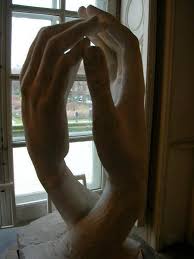
I am fortunate enough to have visited the Rodin Museum in Philadelphia years ago and, although my knowledge of art is limited, I immediately sensed upon seeing his work a fluidity that defied the fact that I was looking at a stationary object.
This is what art can do, I thought at the time and still think when I look at the many pieces of his works showing hands , that convey emotions through immovable pieces of sculpture. (In the photo at left, two opposite hands are intertwined at the four fingers with the thumbs touching.)
Rainer Maria Rilke, who worked as Rodin's secretary, wrote: "There are among the works of Rodin's hands, single small hands, which without belonging to a body, are alive. Hands that rise, irritated and in wrath; hands whose five bristling fingers seem to bark like the five jaws of a dog of Hell." And there is also tenderness in the sculpture above, a touching, a digital disembodied embrace.
Of course what does all this have to do with disability? Do I now fancy myself an art critic? No, I didn't even finish Art History at Rutgers, but fled back to an extra class of Shakespeare, leaving a very grateful art professor shaking his head behind me after I tried to quote literary references for an Escher piece.

"Oh no!" he exclaimed and not enthusiastically. "An English major."
I sighed because my wisdom was not appreciated and, at the next opportune moment, slunk back to the dean's office to drop the "art" course and return to my dear English department where I belonged. I thought. I was still in my teens and didn't understand that I would run into more Escher-like things than not, nor did I understand that living the question is often the best course of action, as Rilke pointed out. And I think, perhaps, that it has been my disability which has taught me that a willingness to live the question is key.
Have patience with everything that remains unsolved in your heart. Try to love the questions themselves, like locked rooms and like books written in a foreign language. Do not now look for the answers. They cannot now be given to you because you could not live them. It is a question of experiencing everything. At present you need to live the question. Perhaps you will gradually, without even noticing it, find yourself experiencing the answer, some distant day.
Letters to a Young Poet
Tuesday, January 13, 2009
Millions overcharged by health insurer
UnitedHealthGroup has agreed to a $50 million settlement after an investigation by the NY Attorney General's office pursuant to " hundreds of complaints about Oxford Insurance and its parent company UnitedHealthGroup" revealed that it "relied on Ingenix, a research firm owned by UnitedHealthGroup" to come up with reimbursement rates, according to MSNBC.
New York Attorney General Andrew Cuomo says Ingenix has been manipulating the numbers so insurance companies pay less. In a just-released report, he contends that Americans have been “under-reimbursed to the tune of at least hundreds of millions of dollars.” Although UnitedHealth Group and Oxford Insurance were the only entities investigated, other major insurers use Ingenix, including Aetna, CIGNA and WellPoint/Empire BlueCross BlueShield.
More insurers are under investigation.
New York Attorney General Andrew Cuomo says Ingenix has been manipulating the numbers so insurance companies pay less. In a just-released report, he contends that Americans have been “under-reimbursed to the tune of at least hundreds of millions of dollars.” Although UnitedHealth Group and Oxford Insurance were the only entities investigated, other major insurers use Ingenix, including Aetna, CIGNA and WellPoint/Empire BlueCross BlueShield.
More insurers are under investigation.
The Lost Prince
The video below shows a few scenes from the BBC miniseries The Lost Prince, which I watched last night. From the BBC drama site:
For history buffs, the miniseries deals with King George V, Prince John's father and Edward VII, his grandfather, as well as the murder of the Tzar and his family.
It also shows how a child with epilepsy was kept out of sight so effectively that no one knew who he was.
Acclaimed writer and director Stephen Poliakoff tells the little-known story of Prince John, youngest child of George V and Queen Mary, whose short life spanned one of the most momentous periods in history - the political build-up to the First World War and the machinations of European royalty in the early part of the 20th century.
Diagnosed as an epileptic, and suffering from autistic-like learning difficulties, Prince John is unable to participate in public life and becomes increasingly isolated from his family.For history buffs, the miniseries deals with King George V, Prince John's father and Edward VII, his grandfather, as well as the murder of the Tzar and his family.
It also shows how a child with epilepsy was kept out of sight so effectively that no one knew who he was.
Monday, January 12, 2009
Why has Yes We Can become No We Can't for people with disabilities?
.....about excluding people with disabilities at the inauguration. Here's what's out there and if you write about it, please leave me a link in the comments - or if you want to do a roundup, please feel free to use these links.
First I read Planet of the Blind
An ABC television affiliate in northern Virginia reports that the Obama inauguration planning has been devised so as to discourage people with disabilities from attending. Surely one can understand how the problems of logistics--how to move people with mobility accommodations through the vast thrhongs of citizens who will be clogging the streets and the public transportation systems can't be easy to resolve. And yet I would argue that this logistical difficulty or the fact that making accommodations isn't easy is always the excuse that's trotted out by the benignly ableist city planners, architects, aircraft engineers, academic dean's offices, stadium officials, software developers, manufacturers of technologies, restaurant owners, oh on and on the list can go.
I wrote my post Standing By below. Then I heard from Bill over at Bad Cripple who said he wrote a post
How can the organizers of the inauguration justify the exclusion of people with disabilities? According to Carole Florman, spokeswoman for the the organizing committee "We can't do anything about traffic, we can't bring people closer for drop-off than the security perimeter will allow, we can't do anything about the fact that the city is closing bridges". Wow, that is a long list of things that can't be done.
and I found this post at The Right to Design
If you plan an event and just say "people with disabilities, we suggest you do not attend," you are not really confronting the real issues about what it is like to hold large, public events. Not to mention the symbolism of more or less disinviting disabled or older folks to what the new administration is claiming to be "the most open and accessible Inauguration in American history" (from a letter I received from Obama-Biden since I volunteered for their campaign). I really think we need to examine how logistical complications become an easy go-to for exclusion or prejudice in "homeland security" contexts.
At Feministe , it is suggested that advocates be asked for suggestions for solutions:
While it would probably be a logistical impossibility to do the same for every person with a disability who plans to attend, how hard would it be to charter a couple of accessible buses with security clearance and even guards if necessary? You could set up a drop-off point for people with disabilities/limited mobility (which seems to already exist), and do a few shuttle runs. The traffic may be extremely heavy, but it’s still doable. And that’s just my idea after thinking about it a few minutes — I’m sure that those who advocate for greater accessibility on a daily basis could come up with many other suggestions for them.
We need to approach these situations with a Yes We Can attitude. All of us acknowledge the security issues. We also know our infrastructure doesn't meet the demands of being included in everyday life - including transportation, housing, etc. Maybe, in fact, the inauguration highlights that in a way where more people will "get it" - certainly we as a society still engage in a denial about how far we have to go with inclusion. I've listened to friends weep who can't attend funerals or weddings, or spend holidays alone because houses are not accessible, or can't go with friends to events of all kinds. We've all been told that this is "our lot in life", this is "the way it is" and, on the other hand, we all wonder why a stigma still attaches to being disabled.
Yet when one says words like universal design, blank stares ensue. Why does this happen when we talk about solutions? Because in 2009 in the US, people still fail to believe that yes we can work together to change some of these problems, rather than viewing exclusion as the norm and giving in to no we can't. That is the message this is sending not only to adults with disabilities, but to our children with disabilities. And I want them to believe in our future and work toward yes.
Yes we can brainstorm solutions. Yes we can strive for better inclusion.
Yes we can start.
Now.
Other links:
Obama and Accessibility: A Disturbing Trend
Failing to plan is planning to fail--and when you're not including, you're excluding. (And don't tell me it's too hard, we KNOW you can overcome obstacles!)
What is this? Health care reform community discussion site is inaccessible?
.
First I read Planet of the Blind
An ABC television affiliate in northern Virginia reports that the Obama inauguration planning has been devised so as to discourage people with disabilities from attending. Surely one can understand how the problems of logistics--how to move people with mobility accommodations through the vast thrhongs of citizens who will be clogging the streets and the public transportation systems can't be easy to resolve. And yet I would argue that this logistical difficulty or the fact that making accommodations isn't easy is always the excuse that's trotted out by the benignly ableist city planners, architects, aircraft engineers, academic dean's offices, stadium officials, software developers, manufacturers of technologies, restaurant owners, oh on and on the list can go.
I wrote my post Standing By below. Then I heard from Bill over at Bad Cripple who said he wrote a post
How can the organizers of the inauguration justify the exclusion of people with disabilities? According to Carole Florman, spokeswoman for the the organizing committee "We can't do anything about traffic, we can't bring people closer for drop-off than the security perimeter will allow, we can't do anything about the fact that the city is closing bridges". Wow, that is a long list of things that can't be done.
and I found this post at The Right to Design
If you plan an event and just say "people with disabilities, we suggest you do not attend," you are not really confronting the real issues about what it is like to hold large, public events. Not to mention the symbolism of more or less disinviting disabled or older folks to what the new administration is claiming to be "the most open and accessible Inauguration in American history" (from a letter I received from Obama-Biden since I volunteered for their campaign). I really think we need to examine how logistical complications become an easy go-to for exclusion or prejudice in "homeland security" contexts.
At Feministe , it is suggested that advocates be asked for suggestions for solutions:
While it would probably be a logistical impossibility to do the same for every person with a disability who plans to attend, how hard would it be to charter a couple of accessible buses with security clearance and even guards if necessary? You could set up a drop-off point for people with disabilities/limited mobility (which seems to already exist), and do a few shuttle runs. The traffic may be extremely heavy, but it’s still doable. And that’s just my idea after thinking about it a few minutes — I’m sure that those who advocate for greater accessibility on a daily basis could come up with many other suggestions for them.
We need to approach these situations with a Yes We Can attitude. All of us acknowledge the security issues. We also know our infrastructure doesn't meet the demands of being included in everyday life - including transportation, housing, etc. Maybe, in fact, the inauguration highlights that in a way where more people will "get it" - certainly we as a society still engage in a denial about how far we have to go with inclusion. I've listened to friends weep who can't attend funerals or weddings, or spend holidays alone because houses are not accessible, or can't go with friends to events of all kinds. We've all been told that this is "our lot in life", this is "the way it is" and, on the other hand, we all wonder why a stigma still attaches to being disabled.
Yet when one says words like universal design, blank stares ensue. Why does this happen when we talk about solutions? Because in 2009 in the US, people still fail to believe that yes we can work together to change some of these problems, rather than viewing exclusion as the norm and giving in to no we can't. That is the message this is sending not only to adults with disabilities, but to our children with disabilities. And I want them to believe in our future and work toward yes.
Yes we can brainstorm solutions. Yes we can strive for better inclusion.
Yes we can start.
Now.
Other links:
Obama and Accessibility: A Disturbing Trend
Failing to plan is planning to fail--and when you're not including, you're excluding. (And don't tell me it's too hard, we KNOW you can overcome obstacles!)
What is this? Health care reform community discussion site is inaccessible?
.
Sunday, January 11, 2009
Better late than never
Vote for Blue Girl here.
Her blog is up for Best Diarist in the Weblog awards and I meant to put up a post this week but it's been hectic. So to make up for that I changed my banner heading to blue. It was maroon in case you didn't notice. But we're thinking blue around here.
You should vote for Blue Girl because she IS the Best Diarist. Whether she writes about her son, Blue Kid, or her family or life....she writes things like this:
Her blog is up for Best Diarist in the Weblog awards and I meant to put up a post this week but it's been hectic. So to make up for that I changed my banner heading to blue. It was maroon in case you didn't notice. But we're thinking blue around here.
You should vote for Blue Girl because she IS the Best Diarist. Whether she writes about her son, Blue Kid, or her family or life....she writes things like this:
Blue Kid got up this morning and stumbled into the living room and fell on the couch. His eyes were droopy and his hair was sticking up every which way. He was resting his head on his hand when a story about Blagojevich came on the news.
Blue Kid said, "I don't get what the big deal is. All he did was sell a chair on Ebay."
"What?"
"He just sold a chair on Ebay and everyone got all crazy about it."
It took me a minute to figure out what he was talking about.
I laughed, "He didn't sell a chair on Ebay! He was trying to sell Obama's Senate seat!"
"Oh." Then he covered himself up with a blanket, turned over on his side and went back to sleep.
See?
Saturday, January 10, 2009
Standing by

When I heard about Obama's train trip, I remembered the day my father took all of us to watch as Bobby Kennedy made his final journey by train to Washington after his assassination.
We piled into our station wagon. Our mood turned solemn as we joined the silent group standing by the tracks. A few people were wiping their eyes.
My father gazed into the distance, squinting. He had calculated the exact time the train would arrive and, considering his father was a train engineer, I figured he'd be right.
He was. The train appeared on the horizon. It was not traveling fast, nor was it traveling slowly. It seemed surreal, as if the train was floating by. I saw the black bunting and thought I saw a few figures move near the windows. A hand inside waved at the silent crowd.
Moments later as the train chugged into the distance, everyone began to walk back to their cars. "Who was that?" people asked, guessing, naming members of the Kennedy family. "Teddy? Ethel?"
"This is history, kids," my father said, as we trooped back into the car. "This is something you'll always remember."
There are other history lessons I've learned since then, lessons about disability history, for example. I've learned that people with disabilities are still struggling to be included in public events, to be a part of, to have access and achieve the simple act of being able to show up.
I hope many people have the chance to be a part of the upcoming inaugural events. And I pray that future generations of people with disabilities will have a better chance to attend the inauguration. Because what I'll remember from this inauguration is how exclusion because of lack of access and inadequate transportation results in so many people with disabilities not being able to stand by and witness events. And that feels surreal too.
[photo from JFK News and Updates]
[image description: A crowd stands along the train tracks waiting for Robert Kennedy's body as he was transported to Washington DC after his assassination. The crowd includes several nuns, Catholic schoolgirls in uniform, and several families. In the background is a parking lot with cars.]
Petition: Announcement
from a comment left by Andrea over at We Can Do
Jerry Lewis, the man who runs the annual Telethon to raise money for people with muscular dystrophy in the US is about to receive a humanitarian award. Many people in the disability community is protesting this award because they feel that Jerry perpetuates and entrenches negative, harmful stereotypes toward people with disabilities. More about the petition campaign at: http://www.petitiononline.com/jlno2009/petition.html
There is also a Facebook group at http://www.facebook.com/group.php?gid=40538392681
Jerry Lewis, the man who runs the annual Telethon to raise money for people with muscular dystrophy in the US is about to receive a humanitarian award. Many people in the disability community is protesting this award because they feel that Jerry perpetuates and entrenches negative, harmful stereotypes toward people with disabilities. More about the petition campaign at: http://www.petitiononline.com/jlno2009/petition.html
There is also a Facebook group at http://www.facebook.com/group.php?gid=40538392681
Thursday, January 8, 2009
This is a strange week
Meredith emailed me that this has been a strange week and, indeed, it has.
My mom just got out of the ICU and was transferred to a care center for rehab, where she may be staying awhile. It's like take two: when we tried this last week at another care center, she fell again and wound up back in the hospital, complicating her recovery, and having to undergo more procedures on New Year's Eve.
Fortunately, I come from strong stock so her biggest concern today was that next time she wants me to bring her fresh fruit salad because they "serve that canned fruit".
I was absolutely delighted that this was what she had on her mind and relieved that, although she is still dealing with broken bones and a few other serious issues, she's in good spirits. Except about the lack of fresh fruit.
What my mom doesn't realize is that I almost didn't get inside to see her because the handicap spots were taken by cars without handicap placards or plates. What I did was park in two spots and drop an orange cone down in one to make sure no one blocked me in, but when I came out an irate driver chewed me out about that even though there were lots of empty regular spots. I rolled past him and got in the van and left without explaining that I had to do that in order to get in to see my mom since I didn't have the time to come back to check when the illegal parkers were done with the handicap spots. (You know how they all say they're just running inside? That's not true.)
Anyhow, that didn't seem like a good use of my time.
It all feels very much like I'm living in an alternate universe when these things happen, when people in parking lots scream at me for using two regular spots out of twenty empty ones with a handicap van with an eight foot ramp I have to deploy for a power chair, but no one is upset about the three limited handicap spots being taken up by those who park illegally.
My mom just got out of the ICU and was transferred to a care center for rehab, where she may be staying awhile. It's like take two: when we tried this last week at another care center, she fell again and wound up back in the hospital, complicating her recovery, and having to undergo more procedures on New Year's Eve.
Fortunately, I come from strong stock so her biggest concern today was that next time she wants me to bring her fresh fruit salad because they "serve that canned fruit".
I was absolutely delighted that this was what she had on her mind and relieved that, although she is still dealing with broken bones and a few other serious issues, she's in good spirits. Except about the lack of fresh fruit.
What my mom doesn't realize is that I almost didn't get inside to see her because the handicap spots were taken by cars without handicap placards or plates. What I did was park in two spots and drop an orange cone down in one to make sure no one blocked me in, but when I came out an irate driver chewed me out about that even though there were lots of empty regular spots. I rolled past him and got in the van and left without explaining that I had to do that in order to get in to see my mom since I didn't have the time to come back to check when the illegal parkers were done with the handicap spots. (You know how they all say they're just running inside? That's not true.)
Anyhow, that didn't seem like a good use of my time.
It all feels very much like I'm living in an alternate universe when these things happen, when people in parking lots scream at me for using two regular spots out of twenty empty ones with a handicap van with an eight foot ramp I have to deploy for a power chair, but no one is upset about the three limited handicap spots being taken up by those who park illegally.
Windows 7 : beta download available tomorrow
Looks like Windows 7 has "touch" and "gesture" features that might work for some folks with disabilities (see video demonstration below).
A beta version is available for download, beginning tomorrow. (At your own risk, it's beta!) For an indepth view, click here.
And just for fun - air hockey!
A beta version is available for download, beginning tomorrow. (At your own risk, it's beta!) For an indepth view, click here.
And just for fun - air hockey!
Tuesday, January 6, 2009
Taking things for granted?
Michael, blogging over at Disaboom, says that's the opposite of gratitude in this great post.
Monday, January 5, 2009
New year resolution number five: Giving customers with disabilities access and service
Yesterday I ate a meal at a restaurant where I had the best service I've ever had in my life from the waitress, yet we didn't speak the same language. It made me think about how too often we get caught up in the excuse that customers with disabilities don't ask for what they need or ask the wrong way, when so much of the service and accommodations needed are just about common sense.
The Mexican restaurant was in a strip mall, tucked away between two nondescript storefronts. When I rolled in, I saw there were about eight tables inside. The place was busy and there was one waitress, who took orders, bussed the tables, brought the food and seated customers.
The food in front of other customers looked great. I rolled up to a table and the waitress asked me where I'd like to sit and moved the chairs. (Yes, I do speak some Spanish, but there are different dialects and I don't always know the nuances.) She brought me a menu and a diet coke, opened the can and put a straw in at my request - immediately. I didn't have to wait until "someone had time" which often happens. My food was cut up as requested and when my meal was over, she was kind enough to even wash my special eating utensil for me. It was a great dining experience.
In contrast, the day before I stopped in at a different Starbucks than I usually do, in a ritzy mall. The counter was not accessible at any spot, yet none of the staff even "heard" me when I asked them to bring my beverage around to me. Nor did they "hear" me when I needed assistance with opening the cover on the beverage, which required dexterity. After I requested help more than half a dozen times from employees, customers assisted me with those things. [There was also no handicap seating - chairs everywhere that had to be moved which I can't do and the women's bathroom door opened in such a way that my wheelchair became stuck between that door and the door to the men's room.]
Ironically, there was a sign posted at the Starbucks with state phone numbers alerting customers where to report discrimination. By the time an employee came over to me, the customers had already helped me, but I did point the sign out to her and asked to speak to the manager. I was told the manager was too busy, that they were all busy, in a very patronizing manner. This was after no one deigned to even make eye contact with me for ten minutes as I tried to talk to them.
Maybe, just maybe, when we talk about handicap awareness for employees regarding respectful customer service, we need to remember that a large part of it involves a language of the heart. And when it comes to mom and pop businesses, they are often light years ahead in that regard. Not always, but it's food for thought.
The Mexican restaurant was in a strip mall, tucked away between two nondescript storefronts. When I rolled in, I saw there were about eight tables inside. The place was busy and there was one waitress, who took orders, bussed the tables, brought the food and seated customers.
The food in front of other customers looked great. I rolled up to a table and the waitress asked me where I'd like to sit and moved the chairs. (Yes, I do speak some Spanish, but there are different dialects and I don't always know the nuances.) She brought me a menu and a diet coke, opened the can and put a straw in at my request - immediately. I didn't have to wait until "someone had time" which often happens. My food was cut up as requested and when my meal was over, she was kind enough to even wash my special eating utensil for me. It was a great dining experience.
In contrast, the day before I stopped in at a different Starbucks than I usually do, in a ritzy mall. The counter was not accessible at any spot, yet none of the staff even "heard" me when I asked them to bring my beverage around to me. Nor did they "hear" me when I needed assistance with opening the cover on the beverage, which required dexterity. After I requested help more than half a dozen times from employees, customers assisted me with those things. [There was also no handicap seating - chairs everywhere that had to be moved which I can't do and the women's bathroom door opened in such a way that my wheelchair became stuck between that door and the door to the men's room.]
Ironically, there was a sign posted at the Starbucks with state phone numbers alerting customers where to report discrimination. By the time an employee came over to me, the customers had already helped me, but I did point the sign out to her and asked to speak to the manager. I was told the manager was too busy, that they were all busy, in a very patronizing manner. This was after no one deigned to even make eye contact with me for ten minutes as I tried to talk to them.
Maybe, just maybe, when we talk about handicap awareness for employees regarding respectful customer service, we need to remember that a large part of it involves a language of the heart. And when it comes to mom and pop businesses, they are often light years ahead in that regard. Not always, but it's food for thought.
Sunday, January 4, 2009
Getting to awe
The magi have arrived, bearing gifts, after their long, arduous journey. As I wrote the other day, as pilgrims they made their journey looking for a source of awe.
Sometimes I think we all have lost that sense of awe toward God in a world that is so full of distractions, it's difficult to even lift our gaze toward spiritual things. Our eyes are fixed on iPods, tech devices, computer screens more than ever and less on each other, and as for prayer and talking to God, many of us say we don't have time or, if we do, precious little, for our Creator and Savior. (Of course adding those last two words puts a perspective on it that makes the statement rather inane.)
Yet, with a bit of thought, it takes very little to get to awe. Just thinking about the fact that God is omnipresent, for example, makes me feel awe. He is everywhere. Not just in the sense of everywhere as we think of it - in our homes, our offices, the store, etc. but also in our heads. Call it mind reading or thought recognition, but God is all knowing or, as I used to write out in grammar school All Knowing.Which means He knows why we 'don't have time' for prayer and communication with Him.
Of course He knew the magi were coming. He knew they were bearing gifts. He also knows what gifts and talents we bring to the table. He knows whether we use them or not. There are opportunities put in front of us every day to do so and He leaves it up to us to make choices. We can make the pilgrimage, take the journey or go another route. We can choose convenience and the express lane. We can go to bed without praying, wake up without expressing our gratitude and live as if we don't have a Creator or Savior and don't know him.
We can choose not to get to awe.
On this day, as the magi arrive, I'm spending some time thinking about what's getting between me and awe. I wonder where unnecessary limits in my life arise and how to deal with those. I'm thinking about ways I miss opportunities to get to awe. I'm checking my road map with a different kind of GPS - not for the fastest physical route, but the best spiritual one, the one where I can be of most service to my brothers and sisters in Christ. That's the road I need to travel. I know if I listen closely and take God's direction, I'll find it.
Sometimes I think we all have lost that sense of awe toward God in a world that is so full of distractions, it's difficult to even lift our gaze toward spiritual things. Our eyes are fixed on iPods, tech devices, computer screens more than ever and less on each other, and as for prayer and talking to God, many of us say we don't have time or, if we do, precious little, for our Creator and Savior. (Of course adding those last two words puts a perspective on it that makes the statement rather inane.)
Yet, with a bit of thought, it takes very little to get to awe. Just thinking about the fact that God is omnipresent, for example, makes me feel awe. He is everywhere. Not just in the sense of everywhere as we think of it - in our homes, our offices, the store, etc. but also in our heads. Call it mind reading or thought recognition, but God is all knowing or, as I used to write out in grammar school All Knowing.Which means He knows why we 'don't have time' for prayer and communication with Him.
Of course He knew the magi were coming. He knew they were bearing gifts. He also knows what gifts and talents we bring to the table. He knows whether we use them or not. There are opportunities put in front of us every day to do so and He leaves it up to us to make choices. We can make the pilgrimage, take the journey or go another route. We can choose convenience and the express lane. We can go to bed without praying, wake up without expressing our gratitude and live as if we don't have a Creator or Savior and don't know him.
We can choose not to get to awe.
On this day, as the magi arrive, I'm spending some time thinking about what's getting between me and awe. I wonder where unnecessary limits in my life arise and how to deal with those. I'm thinking about ways I miss opportunities to get to awe. I'm checking my road map with a different kind of GPS - not for the fastest physical route, but the best spiritual one, the one where I can be of most service to my brothers and sisters in Christ. That's the road I need to travel. I know if I listen closely and take God's direction, I'll find it.
Saturday, January 3, 2009
Friday, January 2, 2009
New years resolution number four: Look for the ability in disability
Yesterday I watched my nephew while my sister went to visit my mom who is still in the ICU, recovering from complications from her fall a week ago.
Both of us enjoy spending time together. I'm always amazed by his progress when I see him, as a result of PT and school. He enjoys creative activities, such as music and film and writing . Although he continues to deal with many issues from his cerebral palsy, his abilities shine when I am with him and, as his aunt, those are what I nurture.
This is a far different mindset than one that I often encounter in our society, where the barriers put in front of people with disabilities, some of which could be dealt with if we all had unlimited funds and resources, often are used to justify labeling them as dis-abled. For example, in a not-so-good school system, my nephew would never have received the services he has to help him with his math, which is a tough subject for him. Nor would he have been able to get much of the equipment he needs - a keyboard to write, for example. And, as a result, he would be more dis-abled, less able to use and show the abilities he has.
I remember years ago when I was traveling with another friend in a wheechair and we passed through a town where all of the restaurants had steps. We sat in front of one of the restaurants and a passerby remarked "How do people like that manage?" And, indeed, we appeared to be very dis-abled at that moment, because we had no way to roll inside.
My friend, however, got annoyed and she rolled over to the bottom of the steps, climbed out of her wheelchair and managed her way up the steps, dragging her wheelchair with her. When she got to the door, she turned and asked "What do you want? I'll get carry out" to the amazement of the passerby.
Not everyone can get out of their wheelchair and crawl up steps, nor should they, but many of us with disabilities do the equivalent every day in order to be "able" in a world that challenges our abilities done in a different way. And here's what I've found - most people with disabilities are creative, resourceful and resilient because of that. They are adaptable, versatile and often develop a great sense of humor as a result of their life experiences.
I'm seeing that in my nephew now too. As we were making lunch together, we came to a point where neither of us could grasp something. We looked at each other and laughed.
"Don't worry," I said. "We'll get resourceful."
Abilities abound in people. Let's not "dis" ability in anyone in the new year.
Both of us enjoy spending time together. I'm always amazed by his progress when I see him, as a result of PT and school. He enjoys creative activities, such as music and film and writing . Although he continues to deal with many issues from his cerebral palsy, his abilities shine when I am with him and, as his aunt, those are what I nurture.
This is a far different mindset than one that I often encounter in our society, where the barriers put in front of people with disabilities, some of which could be dealt with if we all had unlimited funds and resources, often are used to justify labeling them as dis-abled. For example, in a not-so-good school system, my nephew would never have received the services he has to help him with his math, which is a tough subject for him. Nor would he have been able to get much of the equipment he needs - a keyboard to write, for example. And, as a result, he would be more dis-abled, less able to use and show the abilities he has.
I remember years ago when I was traveling with another friend in a wheechair and we passed through a town where all of the restaurants had steps. We sat in front of one of the restaurants and a passerby remarked "How do people like that manage?" And, indeed, we appeared to be very dis-abled at that moment, because we had no way to roll inside.
My friend, however, got annoyed and she rolled over to the bottom of the steps, climbed out of her wheelchair and managed her way up the steps, dragging her wheelchair with her. When she got to the door, she turned and asked "What do you want? I'll get carry out" to the amazement of the passerby.
Not everyone can get out of their wheelchair and crawl up steps, nor should they, but many of us with disabilities do the equivalent every day in order to be "able" in a world that challenges our abilities done in a different way. And here's what I've found - most people with disabilities are creative, resourceful and resilient because of that. They are adaptable, versatile and often develop a great sense of humor as a result of their life experiences.
I'm seeing that in my nephew now too. As we were making lunch together, we came to a point where neither of us could grasp something. We looked at each other and laughed.
"Don't worry," I said. "We'll get resourceful."
Abilities abound in people. Let's not "dis" ability in anyone in the new year.
Thursday, January 1, 2009
New year resolution number three: changing the attitude that people with disabilities are expendable
...or that their lives are worth less.
Medics caught on tape allegedly decide disabled man not worth saving
A disabled 59 year old man who called EMT's for help collapsed by the time an ambulance arrived and the medics were allegedly overheard making remarks "to the effect that he was not worth saving" over the open phone line. They made comments about the state of his house. The article states they talked about it and agreed to say the man was dead when they arrived.
See the poem How? by Dan Wilkins
Fear Not the Disabled
Grim News to Start 2009: Bad Cripple
If Disabled Means Expendable
Medics caught on tape allegedly decide disabled man not worth saving
A disabled 59 year old man who called EMT's for help collapsed by the time an ambulance arrived and the medics were allegedly overheard making remarks "to the effect that he was not worth saving" over the open phone line. They made comments about the state of his house. The article states they talked about it and agreed to say the man was dead when they arrived.
See the poem How? by Dan Wilkins
Fear Not the Disabled
Grim News to Start 2009: Bad Cripple
If Disabled Means Expendable
New year resolution number two: providing safe, accessible transportation to people with disabilities
A 22 year old man with CP was left on a school bus new year's eve in New York city and spent the night alone, while temperatures dropped under 20 degrees.
Authorities said police found Edwin Rivera in a bus yard Thursday morning. He had been on the bus for 19 hours while the temperature outside dropped below 20 degrees.
Rivera, who cannot speak, was being evaluated at a hospital. He was expected to recover
via foxnews.com
See also Cold over at Dave's award winning blog, Chewing the Fat.
Rail Assistance Failing [Disabled] Passengers
The Accessible Journey: Issues for Disabled Passengers
New Year resolution number one: affordable and accessible housing
Let's work on affordable and accessible housing to keep and reintegrate people with disabilities into the community.
The goal: independent living
Read about how one Philadelphia man is working on that :
As executive director of the nonprofit Liberty Housing Development Corp., established in April 2007, he looks to create affordable, accessible housing within existing Philadelphia communities - from apartment buildings to neighborhoods.
a huge and grateful h/t to Media dis&dat which now features a roundup of disability articles and topics - wonderful resource for all of us
The goal: independent living
Read about how one Philadelphia man is working on that :
As executive director of the nonprofit Liberty Housing Development Corp., established in April 2007, he looks to create affordable, accessible housing within existing Philadelphia communities - from apartment buildings to neighborhoods.
With $2.2 million in funding from the U.S. Department of Housing and Urban Development, $240,000 from the Philadelphia Office of Housing and Community Development, and $494,250 from the Philadelphia Housing Trust Fund, Liberty is creating 16 individual one-bedroom apartments in two communities: 11 at the Marine Club Condominiums in South Philadelphia and five at Valmont Towers in the city's Northeast.
Connus' passion for his job is personal: He has mobility and speech disabilities from cerebral palsy.
He noted during the interview that "there was a study in 2000 that 59,000 people need affordable accessible housing just in Philadelphia."
a huge and grateful h/t to Media dis&dat which now features a roundup of disability articles and topics - wonderful resource for all of us
Subscribe to:
Posts (Atom)