Pages

Wednesday, October 31, 2007

Did you see the Great Pumpkin?


I know it exists. Sorry if you didn't see it. I didn't see it either - yet.

Every year those of us who sit in the pumpkin patch and wait for the Great Pumpkin know there's a good chance we won't see it. It doesn't matter to us. We still hold true to the idea because we know what it symbolizes to each of us.

To me I dream about inclusion. I dream about access. I dream about ways to help people make their dreams come true - like getting assistive technology, equipment and jobs if they want them - at decent pay - housing and transportation.

I just don't sit around the pumpkin patch all year. I work toward making some of this happen in very small ways. I think because of that I see glimpses of the Great Pumpkin's spirit all year which keeps me going. It's on a small scale but that's enough to keep the spirit alive.

To me the problem isn't whether we actually see the Great Pumpkin but whether we can imagine seeing it and if we know what it symbolizes for us. We need to keep working toward a world where those who laugh at, try to talk sense into or,yell at those who wait for such things are outnumbered by the rest of us.

Happy Halloween to everyone.

[visual description: Linus is in the pumpkin patch getting yelled at by Charlie Brown's sister, who does not believe in the Great Pumpkin. ]

Tuesday, October 30, 2007

The Adventures of Ergo

Synopsis: Eugene got tired of seeing people park in handicap spots illegally....and did something about it. He sewed an "E" on his shirt and went out in his purple wheelchair and moved those cars right out of those spots! Then he delivered a mugger to police in broad daylight - and to his surprise two kids took pictures of him which landed him on the evening news....

a new story for kids of all ages over at A Different Light

The definition of overkill.....

I read a story this morning (link above) about how scientists found the oldest living animal and then killed it. It was a clam that, according to the rings they found after they cut it open, appeared to be over 400 years old, perhaps more.

And this led me to thinking about how overanalyzing the shortage of home health care aides, rather than fixing the problem, is doing the equivalent of cutting open the clam rather than looking at the big picture. The oldest living animal isn't the oldest living animal when it's dead, is it? And providing help to people with disabilities isn't help when it doesn't happen.

This past weekend I fell through the cracks of the system. A back up aide failed to show up although arrangements were made well in advance. This isn't the first time - or the last time - this has happened to me. The shortage of home health care aides doesn't just affect our ability as people with disabilities to get an aide - but the agency's ability to hire and fire and maintain a quality staff.

We can all get into a debate - which is usually the knee jerk reaction when I bring this subject up - about the low wages that aides get. This is undoubtedly true.

But where does that leave those of us who, like it or not, are physically dependent on aides? I want to know when we are going to get to the heart of the matter here. When are we going to stop cutting open the clam to find out how old it is, stop analyzing the situation and come up with solutions?

For a quadriplegic feeding oneself , cutting up food, being able to prepare food, dressing oneself and a myriad of other things people take for granted can be added to the list of things that require assistance. That's not to say in some melodramatic way that my life lacks quality because my physical disability prevents me from doing some of these things easily or at all - but to point out the impact of the lack of services on my quality of life. For those who do not know the level of care required, they may not understand why it's such a big deal if aides don't show up or I don't have help.

And then there is the issue of privilege, which Elizabeth over at Screw Bronze was just blogging on : privilege.

This privilege thing, which by the way various people define differently, is a much bigger part of what blocks progress with issues of access and services than most think. If those with privilege assume they will never need access or services, then "fixing" the problems and addressing them by putting resources toward them isn't a priority.

To the person who is hungry, this issue is important. To those passing by the door of her house on the way to a restaurant, it doesn't exist.

Many who think disability couldn't happen to them find out when it does happen that privileges are not only created by society but sustained by it. I suppose it comes down to being our choice as to how we use those privileges.
“The friend who can be silent with us in a moment of despair or confusion, who can stay with us in an hour of grief and bereavement, who can tolerate not knowing... not healing, not curing... that is a friend who cares.”
-Henri Nouwen

Monday, October 29, 2007

Topchair inventor shown in video climbing stairs to Eiffel Tower


I saw this video showing the Topchair, which is being sold in France and marketed in other countries. The inventor is shown climbing the stairs on his way to the Eiffel Tower....very cool. It appears there is a tractor-tread underneath the chair which grabs the edges of the steps as the chair descends - and the drive wheels (and other wheels) lift out of the way and/or support the descent....

Email Question: Is it true that there was an Ugly Law before the ADA?

...because in the Music Within they talked about it?
A Reader


Dear Reader:
Yes there were several places that had an Ugly Law that affected people with disabilities. Chicago was the last to repeal theirs in 1974. The passage of the ADA has perhaps obscured some of the public's awareness of the fact that it wasn't that long ago that a person with a disability was , in some cases, fined for appearing in public. However this is a very real part of the experience of some disabled people who are still alive - and a cautionary flag in our common history as to the importance of continuing to raise awareness about the need for inclusion.

I've linked above to an article that addresses the history of these laws in a very readable way - and links it to the story of Richard in the movie Music Within.

This is how the Chicago Municipal Law read before its repeal:

"No person who is diseased, maimed, mutilated or in any way deformed so as to be an unsightly or disgusting object or improper person to be allowed in or on the public ways or other public places in this city, or shall therein or thereon expose himself to public view, under a penalty of not less than one dollar nor more than fifty dollars for each offense."

Thanks for your question .

Everyone ELSE can go see Music Within....

Ironically, the same lack of access that resulted in protests by disability activists when the film Coming Home was in theaters in 1978 still exists as the film Music Within is shown in 10 cities around the US.

Go on over to Wheelchair Dancer to read an interesting post about why everyone ELSE has access to this film - but many of us won't....

"MP's want clearer rules on abortion of the disabled"

hat tip to Monastic Musings

Sr. Edith writes about this article in the Daily Mail which reports that:

"The law governing the abortion of "seriously handicapped" babies should be made clearer, an influential committee of MPs is to say.

An inquiry will call for a clearer definition of disability, amid claims that growing numbers of foetuses are being aborted for conditions that can be cured."


To read the rest of the article click above.

Sunday, October 28, 2007

Top Ten Reasons to Give a Fake News Conference

10. You can be a trend setter
9. You don't have to answer all those silly questions
8. You don't have to do any preparation
7. You don't have to show up
6. You can have fun interviewing people to do it, like clowns and jugglers
5. You can play golf while it's being held and still be paid
4. It satisfies the little people
3. It projects an image that "something" is being done
2. It could be a part time job for your unemployed brother in law
and the number one reason to give a fake news conference is:
1. Nothing that's said at it counts!

Music Within: NY Times review


The NY Times calls it inspirational and - in a back handed compliment, says what should be a tough movie to get through is actually - well - pretty good. It notes the need to spread the word about this movie that depicts events leading up to and around the beginnings of the American with Disablities Act and its movement.


It is the story of Richard Pimental, who is rejected by a college professor for a speech sholarship because he has no point of view. Little did anyone know that his path in life would lead him to become a disability activist....

"Richard joins the military. A bomb blast during a tour of duty in Vietnam robs him of much of his hearing. Returning to the same Portland, Ore., campus, he falls in with his "traveling freak show": Mike Stoltz (Yul Vazquez), a fellow veteran filled with rage, and Art Honeyman (Michael Sheen, just terrific), a wheelchair-bound student afflicted with cerebral palsy and a wicked wit. The lover Richard chooses, Christine (Melissa George), is beautiful, blond and normal but believes in open relationships, so he is forced to share her with another man.

He quits a lucrative job to get disabled people jobs, which he and Mike prove supremely good at. When a restaurant refuses to serve Art a birthday breakfast, their arrest turns him into an activist.

The screenplay by Bret McKinney & Mark Andrew Olsen and Kelly Kennemer does a fine job of shoehorning the events of Pimentel's colorful life into a tight but jaunty structure. It also helps that the film can explore mental illness, war injuries, gross disabilities, suicide, lost love and parental rejection and never loose its optimistic nature. It's the opposite of Pollyanna-ism; this group goes in for naughty, mordant humor that deflects all the negativity and prejudice."
-via NY Times

Well I'm going to go bind myself into my wheelchair and deal with my affliction now......sigh.....when will people remove this kind of language from reviews that ostensibly recognize the need to get rid of negativity and prejudice? Anyway here's the trailer which I managed to find despite my affliction....

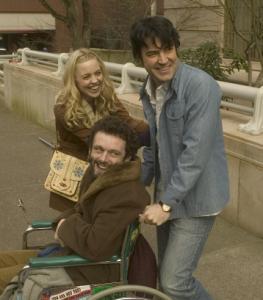
[visual description: Three of the main actors are shown. Richard is standing behind Art's wheelchair which is shown from the left side, and Christine, his girlfriend, stands on the right side of the wheelchair.]

Saturday, October 27, 2007

Parents of son with autism sue school district

"At their son Jack’s second birthday party, David and Kim LaPierre noticed he was shutting out the other children, their first inkling that he was autistic. They enrolled him in a private preschool for children without disabilities and with more than 30 hours a week of therapy at home, he began to connect with others.

The school district in Springfield, N.J., became responsible for his education when he turned 3, and proposed moving him to a public classroom for disabled children. Fearing that Jack would backslide, the family kept him in private school, suing the schools to recover their expenses.

“It makes no sense to us as parents that we would have to put our son in a place that we knew wasn’t right for him, just so we could qualify for the school’s services or funding to help us.” said Mr. LaPierre, who estimates spending more than $60,000 a year on tuition and therapy.

Cases like these have increasingly become a flash point in special education, pitting parents against school systems that say they cannot afford to pay to privately educate disabled children whose parents unilaterally reject their proposed placements.

Expectations that the Supreme Court would settle whether such parents must try public schools first evaporated after Justice Anthony M. Kennedy recused himself without explanation in two cases from New York State.

...

The federal Individuals with Disabilities Education Act guarantees a “free appropriate public education” for children with disabilities. Most of the nation’s nearly six million special-education students attend public school, but the law allows parents to seek public financing for private schools if they can show that the public schools cannot adequately serve their children.

As of 2005, more than 88,000 disabled students were educated in private settings at taxpayer expense, an increase of 34 percent over a decade, according to the National School Boards Association. Often school districts acknowledge that they cannot provide an adequate education, and willingly pay for private tuition.

But with an increasing number of parents rejecting public school placements without trying them, courts are grappling with when these plans are appropriate, and whether parents must try them."
-via NY Times

In certain states, different agencies handle the cases - and the plans - for children before and after they begin school. This "relay" is adding to the problem, some officials say. Combined with the lack of guidance from court rulings, parents -and school districts - are being left in a limbo where some say the number of these cases is limited while others fear the cost will be unmanageable.

To read the entire article, click above. You'll find the title interesting - as it reveals a certain slant. But then again I have a nephew with a disability so I know the importance of providing for the specific needs of a child in his or her IEP plan.

A prayer when your back up aide cancels

Via the Curt Jester a prayer from Bishop Vasa

I thought this was a perfect prayer for many occasions, as I sit here waiting to hear if they can now assign me an aide from the emergency list:

"Lord, I give this day entirely to You -- I retain none of it for myself. It is Yours. If on this, Your day, You send me joy -- I thank you. If on this, Your day, You send me loneliness -- I will draw closer to You. If on this, Your day, You send me sorrow -- I accept it. If on this, Your day, You send me peace -- I will share it with the anxious. If on this, Your day, You send me pain -- I will suffer it with You. If I accept good things from You, should I not also accept unpleasant? Since this is Your day, which You graciously have given to me, and which I now in intention return to You, help me to live it well; not to waste what You have given on idleness but to use it as You have designed. Help me to remember how well the day goes when it is given to You. I trust that You will give to me this day all that I need and that all that is given or withheld is for my good. With all this in mind, help me to live this day with You in joy. Amen."

Friday, October 26, 2007

In Our Prayers : Images


....of the evacuees from the wildfires, being served by some of the many volunteers.

[visual description: A long table is shown. On the left side are volunteers placing food on the plates of those on the right side.]

Thursday, October 25, 2007

Too Late to Return

a new short story over at A Different Light

synopsis: A mystery, a thriller - about two wheelchair salesmen who bond in a most illegal way....

Hall of Shame: Wheelchairs and Taxis

This report shows how not listening to the disability community wastes time, money and resources. In this case, purchasing Uplanders as taxis created issues of lack of access for power chair users - whereas side entry Dodge Caravans and back entry Toyota Siennas would solve some of these problems.

Click above to see a video and a story about this.

hat tip United Spinal

Disability Blog Carnival #25: "If"


There's nothing like a great topic to draw out all the best in blogging - and that's what Kara did! Go on over to read an exciting assortment of posts on the topic of "If" - all kinds of "if"s (not whens or whys or hows) but one of the most creative carnivals going....and we got it! Over there...IF you click....

Wednesday, October 24, 2007

Disabled Iraq vet sues Army

A vet whose hand was amputated as a result of injuries sustained while in Iraq is suing the US Army for violating his rights as a person with a disability on his job, saying fellow workers called him names and pushed him out of handicap parking. A copy of the complaint filed in the lawsuit is here.

Martin Mars water bomber....

This plane is going to be used to combat the wildfires...check it out in this video...thank you to our Canadian friend bringing one down...


via canada.com:

"The water bomber will likely be put to work covering homes and structures with a protective covering called Thermo-Gel, which consists of 98 per cent water and a super-absorbent polymer. Fighting the fires right now is just too difficult, said Coulson.

"There's not a hell of a lot you can do with a 60-mph wind and fire coming at you other than just gelling homes to protect as many as you can," he said."

We're Strong People

a new poem over at A Different Light
written as a tribute to the wildfire victims in California after hearing an interview on CNN about what a mother told her young daughter upon learning their house burned down...

Also check out this NY Times article written from comments left by evacuees

Things the temporarily disabled say....and do...

One of the things I've noticed since using a wheelchair is that folks who are recovering from surgeries and injuries and are temporarily using assistive equipment often approach me. And since I've been in a wheelchair quite a while now, I've noticed there's a pattern in what they say. Often it's something like

"This is a lot harder to do than I thought!" or

"Things really aren't as accessible as I thought"

or

"I can't wait for this to be over. I don't know how you do it"

It's hard to know how to react to some of these comments. Do I say something along the lines of "You get used to it?" which, by the way, is large part of why these folks are having a hard time with it. It takes time to learn how to use any kind of mobility device. When I went from a manual wheelchair to a power wheelchair, it took me time to learn how to move it around, what it would do and/or not do. I expected that, however, because I've used a myriad of kinds of equipment.

Or should I be more direct and say "It's not a big deal to me"? I think that's also part of it. The novelty of entering the world as a temporarily disabled person can often make these folks focus entirely on that aspect of their life, which isn't true for those of us who are permanently disabled - at least , I don't think, most of us. I don't give much thought to getting into my wheelchair when I get out of bed. I don't think that walking is an option, which is a lot different than where they are coming from.

It's always a good thing when experiences raise peoples' awareness of access issues IMHO. So when someone says something along those lines, I'm happy to agree that we need to keep working toward more access along with acknowledging the progress we've already made.

Sometimes I've found myself just smiling and saying "Hope you feel better". Because I'm not sure there's any way to explain to people that their experience is a very different one, although it does converge with mine in many ways. I think of them like an exchange student who is temporarily visiting. They enter the disabled experience and then exit it at some point, having become more familiar with issues, but knowing they are going home. And while they are there, the actual experience of being in a foreign country looms largest - at least until it becomes more familiar.

At my church a woman who was on crutches for six weeks spoke to me every week during that experience. When she got off the crutches, that stopped. I said hi a few times and she looked the other way. I found that to be very sad. But it's not the first time it's happened. For her, the trip was over.

On the other hand, I've met many more people who have used their experiences to raise their awareness and emerge from it with a permanent shift of consciousness even when their temporary disability ends. Often these are people who ask if I need help or notice when there isn't access. They share their experience and say "I know a bit about this because I was on crutches...I was in a wheelchair..for six months....for three weeks..."

There is a bond there. Some may argue that it's a different bond, but I'm not sure that's a useful debate. Because in the dialogue toward inclusion, I'm all for letting everyone on the bus for the trip.

Tuesday, October 23, 2007

On the new Vatican directive and 'ordinary care'

A priest discusses the implications of the new Vatican directive.

A Cat Wake Up Call


Anyone who has a cat will appreciate this video...

Safe and Well List

The American Red Cross posts a list where evacuees from the fires can let others know they are safe - and where friends, relatives and others can check. Click above.

Monday, October 22, 2007

San Diego Red Cross donations for fire victims

"In order to provide the best and fastest possible assistance to those affected by the Harris and Witch Creek Fires, the American Red Cross requests individuals make a monetary donation.

Donate Online: Make a secure online donation at www.sdarc.org/donate. Designate option 2 - San Diego/Imperial Counties Local Disaster Fund for your donation to support the Harris/Witch Creek response operations.
Or mail your donation to:
American Red Cross
3950 Calle Fortunada
San Diego, CA 92123
(If you would like your donation to support the Harris or Witch Creek wildfires, please indicate so at the time of your donation.)"

If you click above you'll go to the American Red cross website

Should the iPhone be more accessible?

A discussion over at another blog is linked above....back to work here!

Seeing advocacy as a tool

a new essay over at A Different Light

Sunday, October 21, 2007

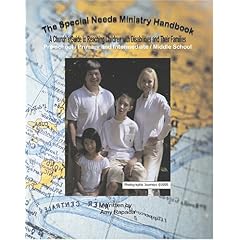
New book for inclusive ministry...


..written by a parent of a child with a disability.

"“The Special Needs Ministry Handbook” offers step-by-step instructions on how to establish a special needs ministry for children pre-school through middle school. The book includes an outline of the process, along with lesson plans, forms, guides to resources, approaches to handling various behavioral issues, tips for helping families of a special needs children, and outreach ideas.

A member of Pine Lake Covenant Church and an educator who also has a severely disabled son, Rapada has presented workshops across the U.S. to help congregations develop special needs ministries. She has drawn on material that she developed and tested over the years for the book.

In her endorsement of the book, Sandy Klein, Pine Lake’s pastor of children’s ministries writes, “This book provides clear, thoughtful and practical strategies and tools for developing a successful special needs ministry.

...“The Special Needs Ministry Handbook” is available at major retail and online bookstores.

Rapada encourages churches to try to start with a model she refers to as “total inclusion,” where children with disabilities participate in regular Sunday school classes, accompanied by a volunteer.

If churches are unable to use this approach, she recommends “reverse inclusion.” The approach calls for “specialized but not isolated” classrooms. Each student is matched with a typically developed student and adult in addition to having a teacher in the classroom. "

via covchurch.org

Via NJ Coalition for Inclusive Ministries list serv

Email questions: on wheelchair bling

I got this email:

"I'm new to using a wheelchair and just out of the hospital. I'm wondering how other women carry stuff around? When I push myself things fall off my lap. J.T."

J.T., thanks for stopping by! This is a great question and I'll answer it, but hope readers leave comments too because different folks do different things.

Many of my friends in manual wheelchairs use backpacks or wheelchair bags that attach to their chairs. There is a "down under" net that you can string under your chair too that holds many items. This is a great place to stow things instead of keeping them on your lap. (You can get these at sportaid.com and 1800wheelchair.com and other places by googling wheelchair accessories and bags).

The good news is that I've noticed more and more designs for wheelchair bags over the years, including really small ones now that hold things like your cell phone (and other bling).

I generally use a wheelchair bag rather than a pocketbook,mostly because the D rings are easier for me with my paralysis, but many of my para friends do carry handbags/pocketbooks.

I highly recommend the site Beauty Ability for fashion tips on wheelchair accessories. I've found that you don't need to buy "only" products made for wheelchairs. Most of the ideas I've learned from other people in chairs and each one will answer this question differently - so check out the comments left here too..

Paraplegic drummer invents ParaPedal


Here's the video about the creation of the ParaPedal - designed by a paraplegic drummer.

Saturday, October 20, 2007

Able Fables: The Kingdom of If Only

over at A Different Light

Vermont Woman wants horse as service animal....

"Cooper, 50, has a severe case of celiac disease, a disorder in which exposure to a protein called gluten destroys the ability of the small intestine to absorb nutrients. One result can be brittle bones, and Cooper has used a wheelchair since she broke her back for the second time four years ago.
Earl, short for Early to Rise, is a 1-year-old miniature tobiano pinto horse that weighs about 100 pounds and is 32 inches tall at the shoulder - just the right height for a frequent face-to-face nuzzle with Cooper as she sits in her wheelchair.
....
Her plan is to attach shafts extending from Earl's harness to her wheelchair. "He'll be able to pull me back and forth to the bus stop and pull me to town. After he's trained he'll be able to go on the bus with me under ADA laws."
via Associated Press

Patty Cooper is working with the Land Trust so that she can keep the horse in her apartment. She says she prefers a horse for a few reasons, one of which is the much longer lifespan over that of a service dog.


To read the rest of the article, click above.

Friday, October 19, 2007

Movie review: Elsker dig for evigt (2002)


I watched this film on Netflix online where it's listed under the English title Open Hearts. It was a hit in Denmark and is directed by Susanne Bier, who's come to my attention through her other work. She's just starting to direct films in English but this film has subtitles which, by the way, were very large and easy to read in block letters.

The film is about a young engaged couple. The man steps in front of a car driven by a doctor's wife, is hit and becomes a quadriplegic. His fiancee, Cecile, is approached by the doctor (the husband of the driver) and they eventually have an affair. Her fiancee is portrayed as a bitter and angry patient, transformed from a likeable character to someone who pushes Cecile away and taunts medical staff.

The characters are well directed and there is an attention to detail in even the shortest scenes. Bier's ability to use close ups of the characters' facial expressions, rather than rely on just dialogue, is extraordinary in her filming, which was done under the austere Dogme method.*

If you're looking for a film that explores the feelings of the partner or spouse of a person with a spinal cord injury , I'd recommend this.

[For an interesting interview of Bier, who also directed After the Wedding, click above.]

[visual description: A scene from the movie - in the foreground in a hospital bed is the quadriplegic with his back to his fiancee, Cecile.]

*This method is described in the article as one "called "the vow of chastity," set out in a movement started by filmmakers Lars von Trier and Thomas Vinterberg in 1995. These rules mandate the use of handheld camera, location shooting, the avoidance of genres and other strictures aimed at guaranteeing cinematic authenticity." -via sfgate.com

Catholic charities' statement on SCHIP veto

"It is disappointing that there were not enough House members willing to
stand up for children and vote to override this ill-conceived veto of a
bill that would have helped so many children without health insurance.
Because of President Bush's veto and the 156 House members who voted to
uphold it, thousands of poor children living in every state will not
receive health insurance coverage that they would have received under
this legislation. Their actions put the health of many of our nation's
children at risk.
"The veto may have blocked this bill, but it cannot stop our commitment
to the most vulnerable in our society. Catholic Charities USA calls on
Congress and the White House to work together to find agreement on a
bill that provides this critically needed health coverage to more poor
children."
-Rev. Larry Snyder, President Catholic Charities USA

Money, blogging and disability


"How much do you make writing your blogs?" a friend asked.

"Nothing," I replied.

"Really? Then why do you do it?"

This guy isn't the first person to ask me that question. Some people simply assume that writing blogs pays money because they've heard that a blogger here or there does get paid. And that can happen. But most people who blog don't get paid.

They do it for other reasons. I feel it helps get the word out about issues concerning disability, for example. I've also managed to help a few people here and there who have contacted me through my blogs. And, of course, I get great personal satisfaction out of blogging which will be all I'll say about that.

I was offered money to blog over at a commercial site recently but turned it down. After considering it, I realized that it would change the nature of my relationship to not only blog posts over there but on here and my other blogs due to the affiliation. . Hardly what I imagined when I first put the words Wheelie Catholic up on my masthead. And I had to think about my future and how that affiliation would fit in when a contract was put under my nose. It didn't.

All of that brings me back to the issue of money and blogging about being disabled. I have never done anything where I've been paid for talking about or educating others about being disabled other than small gifts between twenty five and fifty dollars for speaking engagements or articles. I've done radio and magazine interviews. All for free.

And yes, that does make all of that different. I wasn't signing on to affiliate myself with an organization, to a corporate image - for money.

Yet as the years go by, I envision that for people with disabilities, including myself, decisions like this will become more common. We will find more jobs where we will indeed be paid for talking and writing about the experience of living with a disability. And there's nothing wrong with that as long as one carefully considers the whole picture. Do you agree with the organization's basic goals and mission? Are the organization's goals and missions clearly stated yet? What kind of restrictions are you being asked to agree to that may affect future opportunities? We will all answer these questions differently. There is no right and wrong here - and I don't mean to imply that. Yet when disability becomes a business, it is a very different endeavor than an individual blogging for free.

Money, blogging and disability - and decisions to make, my friends.

[visual description: An image of a sign language symbol for the deaf for money I found online. Two hands are shown - the hand on top has its fingers curled. Two arrows point to a hand below with its palm open.]

A Mass to remember

A bishop says a Mass for the families and friends of a teen with disabilities so he can make his first Communion and Confirmation. Click above to read about it.

Via NJ Coalition for Inclusive Ministries list serv

Thursday, October 18, 2007

Upcoming Events: Candlelight Vigil


Candlelight Vigil


In remembrance of people with

disabilities who had no choice, who

lived & died in institutions.


Friday - October 26, 2007

6:00 - 8:00 p.m.


Front Lawn

Nassau Presbyterian Church

61 Nassau Street, Princeton


Inclusive Community Speakers

Wall of Remembrance

Group Reflections

Prayer/Silence/Song


Organized by the Seeking Ways Out Together Team

Sponsors

NJ Council on Developmental Disabilities

Catholics with Disabilities Network


Please call Chairperson, Jane Dunhamn, 609-984-3379

to register your participation.

Via NJ Coalition for Inclusive Minstries List serv

Dangling

a new poem over at A Different Light
otherwise known as adventures on crutches....

Wednesday, October 17, 2007

Media Access Awards 2007

"Since 1978 the California Governor's Committee on Employment of People with Disabilities has been honoring the entertainment
and media industries with the Media Access Awards


Recipients are honored for their efforts in promoting:

Awareness of the Disability Experience
Accurate Character Portrayals
Innovative Themes
Accessibility
Increased Employment in the Industry
Non-traditional Casting
Depiction of the Diverse American Scene"
-via their website

Actor Jim Troesh received the Michael Landon Award at the 2007 Media Access Awards, held at the Globe Theater at Universal Studios on October 14, 2007, in Universal City, California. Jim, who starred in Highway to Heaven, advocates for people with disabilities. He also directs and stars in The Hollywood Quad videos, available for viewing on YouTube, and is working on a pilot for a TV series on the Hollywood Quad. He also wrote the recent theatrical release about a black Jesus, "Color of the Cross." (You can visit Jim's site by clicking above.)

Congratulations, Jim!

A motorcycle, a quadriplegic: The Seeker


In this documentary, a quadriplegic explores the country on motorcycle as issues of spinal cord injury are discussed.

On the subject of being pushed around

In a wheelchair, that is.

Not this quad. No way. I have a cardinal rule about being pushed - it doesn't happen. That would be why there are no handles on the back of my wheelchair. It's a subtle clue.

I've had people ask about that. "How come you don't have push handles on your chair?"

"Because I don't want anyone to push me," I say.

Simple. Straightforward. No hidden meaning there. If other people want to be pushed I have no disagreement with that. I'm not trying to start an anti-pushing wheelchair campaign. I'm not trying to speak for all people with disabilities.

I was reading a piece today where it says that anyone who speaks as a disability activist or advocate is harming other individual people with disabilities because no one can speak on behalf of all people with disabilities because we are all so different.

I realize that the disability community is diverse. But that doesn't mean that speaking up on issues of common interest is wrong. After all, if that logical reasoning applied, that would discount the value of anyone with a disability ever speaking up. Or in any minority group, for that matter. It would work to keep members of the disability community afraid to say anything on issues affecting us, like health care or voting access or legislation.

Hmmm. That couldn't be what was intended there, could it?

Again, just my insight. I'm not putting it on anyone else. I want to be clear that if anyone else wants to have their chair pushed or disagrees with any of my views on this or any other topic on my blog, go right ahead. Makes no difference to me. But I advocate for equipment to make people as independent as possible, not to settle for being dependent. It reinforces old stereotypes and myths.

Although some may disagree with me, I'm sure I'm not the only one who doesn't like to be pushed around.

Tuesday, October 16, 2007

New to the Blogroll: Disability Resource Directory

h/t to Dream Mom

Rudy, a young man with CP, writes a blog called Disability Resource Directory that's worth taking a look at for its varied content. Not only does it contain many links to resources, but Rudy has written original content over there. (Click above to visit - and say hi.)

Faith and disability

"VALENTE (to Ms. Betenbaugh): For a person of faith with a serious disability, what's the most painful thing for them?

MS. BETENBAUGH: The fact that other people assume that it's related to lack of faith. If you only had enough faith you'd walk again, or you'd be healed if you could just believe enough or trust enough. "
via pbs.org

This PBS feature from 2001 contains interviews with patients at a rehab hospital who talk about their faith as it relates to acceptance of their disabilities. Although each person's response is different, the article does a good job of conveying the broad range of responses an individual can have after acquiring a disability.

It is important to point out, however, that making broad generalizations about how any person will respond can be counterproductive.

Read This to Me

A free service for blind and visually impaired people is available (click above).

"ReadThisToMe allows blind and low-vision people to have printed documents read to them over the phone. All the blind person needs is a phone line and a fax machine (no computer is required.) Here's how it works:

The blind person (whom we'll call the "client") faxes the document to be read to the ReadThisToMe toll-free fax number: 1-877-333-8848. The first page of the fax needs to be a cover page that includes the client's first name and callback (voice) phone number. The document itself can be just about anything: a handwritten letter, a bill, a can of food, a multi-page magazine article -- just about anything that can be faxed.
One of ReadThisToMe's volunteer readers will call the client back and read the document.
That's it!
The service is available throughout the U.S. and is absolutely free (though donations are gladly accepted)."
-via their web site

Monday, October 15, 2007

Blind triathlete breaks two hour record at Olympic distance

"The 25-year-old Scheidies and guide Ben Collins crossed the finish line 48th overall, about 14 minutes behind winner and Australian Olympian Greg Bennett. The field of about 1,100 included 41 professional triathletes.

"“I’m ecstatic,” Scheidies said. “Not necessarily because of what I did, but I wanted to prove to general society that people with disabilities can do things better than able-bodied individuals.”

Scheidies, a Michigan State graduate who lives in Seattle, suffers from juvenile macular degeneration, a condition in which the central vision slowly deteriorates. Only 10 percent of his sight remains.

Legally blind since fourth grade, Scheidies was tethered to Collins for the 1.5-kilometer swim and 10K run. In between, they rode a tandem bike in the 40K cycling leg.

Bennett finished in 1:44.41. His victory gave him a sweep in the five-race Life Time Fitness Triathlon Series and earned $420,000."
via freep.com

Getting the message across when you're in a jam

My printer/copier/etc. machine broke last week. I was thrilled to find that not only had the price of printers come way down (I don't need a laser printer), but I could find a much smaller one which was space saving.

So the printer arrives and Meredith comes over to set it up for me. When you're a quadriplegic and a box arrives, there it sits until someone takes it out and sets it up. Sort of teaches you delayed gratification. On the other hand, some would say it's nice not to have to do it yourself.

Meredith announces that she's set up so many printers that she doesn't need the written instructions. I know this is true because I've watched her set up various things before without ever consulting the instructions. This has included items like desks that came with instructions in languages that neither of us knew. In these cases she hands the instructions to me.

"Tell me what to do next," she says, grinning.

Okay so I was a comparative lit major for a few years and have a smattering of a number of languages. So I make things up. Put that screw there, that thing-a-ma-gig there. And it usually works.

This time the instructions were in English but we didn't bother. I watched as she took the tape off, plugged the printer in, put paper in the tray and then she said "Oh. Paper jam it says." Printers today have these screens that tell you what's wrong. It's almost as if you're just meeting a person and they give you feedback. "No, thank you, I don't like my coffee that way". Instead it's "Don't put the paper in that way".

And I'm sitting there thinking that the printer is text messaging us.

"Want me to check the instructions?" I asked.

"I can do it without instructions," she said, moving the paper around. The printer replied "Paper jam! Paper jam!"

Meanwhile I'm reading the instructions that say if you push the paper in too far, it will say paper jam. So I tell her this and she adjusts the paper and continues setting up the printer. I thank her and she says "Well I'm disappointed I needed the instructions."

Well in a way we didn't. The printer told us what was wrong, just not how to fix it.

For some reason it reminded me of our health care system. We all know it's broken, particularly those of us in the disability community. Over the weekend I spoke with three different people, all of whom have had claims denied through insurance for durable medical equipment. These are claims that used to be allowed a short time ago. All of these people have equipment that has "aged out" and is no longer able to be repaired. They all tell me they're trying to find other ways to replace these items - most have family members who can help. Some don't.

I can't help but feel that we're not getting the message out there loudly enough - that those of us with disabilities, in most cases, can't afford to buy these high priced items.

It feels as we're text messaging one way, however. We're sending out signals - and no one is responding. Perhaps it's because in our system no one wants to admit we need to go back to the instructions to get more information to fix what's wrong. Maybe it's from a lack of effort to address things that concern the disability community. Or maybe no one is bothering to listen to our message.

But we're definitely in a jam here.

Sunday, October 14, 2007

Inclusion, diversity and what flowers teach us

Nature teaches us things. I'm not a pantheist and wouldn't say I worship nature, but lessons abound in it that are sometimes overlooked. I know for myself it's because many of the things I "see" in nature I'm not really seeing. I'm so used to them "being that way" that I overlook them.

Take flowers for examples. Many kinds of flowers are naturally diverse and include various colors and variations. Roses are one example, but there are many others.

Yesterday , as I was pondering inclusion and diversity, I wrote a haiku about it which I posted over on A Different Light.

Petals rose lemon yellow
Pink petals flutter
Inhale their diversity

I found myself thinking about this because I received an email from a teenager who is being teased at school about his disability. He is, in fact, the one I wrote the story "Gravity Sucks" for. My other blog, A Different Light, is full of stories and poems with disability themes that I've written either about - or for - people who email me and think they are the only ones who are going through things because of their disability. It's something I began to do years ago when I was a camp counselor. Back then I wrote songs about what the kids were going through- and found it helped them deal with issues.

Fiction and poetry have a way of presenting things in a very different light, which is why I chose that name for the blog. It's one thiing to write about a topic and yet another to create a character, a story and/or poetry about it. Sometimes the use of imagination or the ability to see someone else go through something helps switch our perspective enough that it's helpful.

After I wrote Gravity Sucks, this teenager told me that he interacted again with the kid(s) who were teasing him and found a way to befriend one of them. Yesterday he emailed me and asked if I would write a poem about how it's more natural for all of us to be together, rather than apart, even though we appear to be different.

I thought that was a really good idea for a haiku. Flowers came to mind because, to me, they have always symbolized dots of hope - perhaps on a field or in a forest - scattered there to remind us that nature is painted in glory for us to enjoy.

How much more that is true when we drop the barriers between us, get to know each other and practice inclusion among human beings!

[If you'd like to visit A Different Light, I've included a link above to one of the essays.]

Saturday, October 13, 2007

Watching Notre Dame this year should count as penance

Sorry guys but it's true. I just watched a Notre Dame player try to catch a ball while he was looking at the field and then did a face plant. No one was near him, no one tripped him. Perhaps it was a shoe lace untied.

And yeah my bloggin' break is over.

Mostly because of Notre Dame. I'm sitting here watching the game and thinking about shoes. A Boston College player catches the ball and his shoe comes off and he manages to finish the play. Then he goes to the sideline and one of the coaches ties his shoe for him. I know because this is the kind of thing they show during a football game.

No one cares anything about my shoes and who ties them. Although it's not me. I tied my last shoe many years ago. I don't miss tying shoes. The only time I cared in the past decade that I couldn't tie my shoes was when my nephew asked me to tie his and I had to send him elsewhere. But now he can tie his own shoes too so that's no longer an issue.

Over the years I've watched lots of people tie my shoes. Everyone does it differently and no one ties my shoes the way I did. I never realized how many variations of shoe tying there are. And here's the funny thing: while people are tying my shoes, they talk to me about how they do it, most of them in a self deprecating way. "This is how I do it," almost all of them say, as if I'm grading them.

And I don't care. I just need my shoes tied.

At first this kind of talk made me uncomfortable, as did the whole idea of needing someone to tie my shoes. But now I find it interesting, as if I'm adding data to my study entitled "Third person shoe tying". I think, after my empirical studies, that people act this way because when they were learning to tie shoes, most of them were told how to do it and treated by their parents as if the way they did it didn't quite measure up, so they wound up feeling as if they never quite got shoe tying down right.

Why else does everyone apologize for how they do it? "I'm sorry, I tie it (tighter, looser, bigger, smaller) than most," is all I hear. "I know I'm doing this wrong." In my book if you tie a shoe and it stays tied for longer than eight or ten hours I'd say you've done just fine.

Such a simple act. Yet apparently it reflects a lot about us.

And then there's the Notre Dame receiver. I really don't think he tripped over an untie shoe lace. But if he did, that's one other reason for him to feel bad about himself. He'll think "I can't even tie my shoes right!" So I'm glad the Boston College player's shoe fell off.

Just like when people apologize to someone who can't tie her own shoes about how they do it, It kind of levels the playing field, don't you think?

A little haiku for you

Over at A Different Light
called Unnatural Hibernation

Thursday, October 11, 2007

Disability Blog Carnival #24: One Year Anniversary


I know, I know - I'm on a bloggin' break. But I HAVE to put up the Disability Blog Carnival - especially the first year anniversary edition , with the theme of Milestones.

When I first went over, I saw the logo which read "Disability Blog Carnival -Can't shut us up now" and smiled. This carnival marks not only the first year anniversary, but is a celebration of our voices. I'm not surprised at all to find out that there have been more than enough volunteers to host the carnival, more than enough posts to put up, more ideas on what milestones is in each blogger's life - because I know what a rich diverse community this is.

And that, my friends, is why I am proud to invite you to click above and join our celebration.

Wednesday, October 10, 2007

Tuesday, October 9, 2007

Bloggin' Break...

Just a note: I won't be posting - am taking a much needed blogging break!

I'll be checking the blog for comments, so feel free to leave those....

Medicare : The noose tightens...

During the recent Congressional discussions on the SCHIP legislation, it was proposed that Medicare recipients who are elderly and/or disabled receive a 13 month rental of power chairs rather than owning them. This language, although it was eventually dropped. may surface again during further discussion.

This change would further immobilize the disability community, which is already struggling to gain mobility under current benefits. Please take a moment to read the article above, find out what proposals that affect our community are being discussed and consider writing your Congressman or woman to explain how such language would affect you and others in the disability community.

Those of us in the disability community need to find our voice and then speak up - before changes like this are voted for by our representatives who may not understand our needs.

China's attitude shifts toward disabled

According to this CNN article, China, who is hosting the Special Olympics this year, is experiencing a shift in attitudes toward those with intellectual/cognitive disabilities - at least in major cities. It is credited in part toward media coverage of one of the Olympians who has become a spokeswoman. The country has also spent millions in promoting the Special Olympics, including a media blitz that includes billboards and videos.

"Natalie Williams, a 21-year-old Special Olympics basketball player from Kentucky, says she's never really been treated like a true athletic star. But that was before she came to the Games in China, which has undergone a major change in its treatment of the mentally disabled.

"They are able to accept special needs people in a way that maybe some other countries do not," Williams says.

Last week, organizers rolled out the red carpet for athletes arriving at the Special Olympics in Shanghai, China. Never before in the 39-year history of the Special Olympics has there been such an extravagant, star-studded opening ceremony. And everywhere in this city, there are billboards with the smiling faces of the mentally disabled promoting the Games."
Via CNN

To read the rest of this article and to view videos associated with it, click above.

Kitchen access


Part of my kitchen remodeling to gain access (an ongoing project) was adding a deep lazy susan under the corner of the counters, like one in this picture. It's been extremely helpful in terms of getting at items with a reacher and holds quite a lot of things , whether you choose to put groceries, dishes or other items on it.

It's also much easier for me to see what's in stock - or not- as I put together a grocery list. All I have to do is turn the lazy susan and I get a panoramic view - which I much prefer to asking someone to check in all sorts of non-accessible cabinets!

[visual description: The corner area under two counters is shown. Two lazy susans, positioned horizontally, have been installed in the corner area and hold kitchen items.]

UK Mom seeks hysterectomy for daughter with CP

In another case reminiscent of Ashley X, a mother seeks a hysterectomy for her 15 year old daughter who has CP, saying that it would be in the daughter's best interest, according to this BBC article.

The director of Scope, Andy Rickell, disagrees, stating that :

"It is very difficult to see how this kind of invasive surgery, which is not medically necessary and which will be very painful and traumatic, can be in Katie's best interests. This case raises fundamental ethical issues about the way our society treats disabled people and the respect we have for disabled people's human and reproductive rights. Scope is concerned that doctors are supporting parents in this case. If this enforced sterilisation is approved it will have disturbing implications for young disabled girls across Britain."

In the article, Rickell urges the government to place extra legal safeguards for the protection of people with disabilities and do more to assist those who care for them, noting there should be "a clear framework put in place for dealing with ethical decisions of this complexity, which places the rights, and best interests, of disabled children at the heart of any decision."

The article goes on to state that :

"Simone Aspis, of the UK's Disabled People's Council, said the case was about Katie's human rights.

She said: "It is very clear to us that no operation should be undertaken if there is absolutely no clinical benefit to the person concerned.

"The operation should not be carried out under these circumstances. We are very aware there are other methods of medical intervention that can be done to help control Katie's pain.

"There's lots of non-disabled women who also experience discomfort in their periods.

"Doctors wouldn't even anticipate in recommending to a parent that their child should have their womb removed. Why should it be the case for this person simply because she is disabled?

"As far as we're concerned that is totally and utterly unacceptable."

via BBC.co.uk

Monday, October 8, 2007

On not reducing sports to a mere search for results..


In addressing the Alpine ski team, Pope Benedict XVI said:

"....when sport is practiced in the right spirit, and with respect for dignity, it helps to promote the development of the person.
Sport helps man to consider his own capacities as a talent and his life as a gift of God. Even when sport is practiced at high levels, it is important to maintain an inner harmony between body and spirit in order not to reduce it to a mere search for results."

The Pope also spoke of virtues "which must always characterize sporting activity: tenacity, a spirit of sacrifice, interior and exterior discipline, ... as well as a sense of justice, awareness of one's own limits and a respect for others. All virtues for which you must train yourselves in daily life."

[visual description: Three young wheelchair racers push their racing wheelchairs during a race on a track.]

Commentary: Reality TV: Behind the camera

There's an interesting article in the NY Times about the role of producers and those involved in the production of reality TV shows - and what happens when the participants being filmed are about to engage in unsafe or illegal behavior. It gives the example of an alcoholic who gets intoxicated and wants to drive off.

This raises questions on legal grounds but also moral ones. When the show Kid Nation was first announced, there was an outcry from groups about child labor laws and agencies protecting children. Is it morally right to put forty kids in a deserted town and do a reality show a la social experiment a la entertainment vehicle? I'm not on the set and don't know what protective measures were taken, so I can't comment on this particular show, but it does raise questions about leaving such decisions up to producers . Local child agencies can provide oversight, but is this sufficient and will it be done in a timely way? Is the protection in place sufficient?

These concerns are the subject of investigations by AFTRA and the New Mexico Attorney General's office according to this LA Times article....

"In a press release, AFTRA National Executive Director Kim Roberts Hedgpeth said that AFTRA would take "all legal and moral steps available to protect the rights of the performers and children on this program."

"We are concerned about reports of abuse arising from 'Kid Nation,' which was produced under the AFTRA National Code of Fair Practices for Network Television Broadcasting," she said. "Under this agreement, the host, announcer, reporters and other professional performers on reality and contest programming are specifically covered by the terms of the Network Code, while the amateur contestants are generally not."

Among the issues the attorney general will review will be the production's permit process, the 22-page contract between parents and the producers, and whether the production company illegally refused to allow inspectors onto the property for routine inspections."

via http://www.latimes.com/entertainment/news/tv/la-et-kidnation27aug27,1,2448150.story?coll=la-entnews-tv

There are potentially all kinds of situations that could occur that require intervention by producers, camera people and the like. Yet the NY Times article (linked via the heading) quotes one producer of an adult reality show as saying they have no legal responsibility to intervene - even on a show called Intervention dealing with an alcoholic driving. To say that ends the issue, however, falls short in my opinion. I'm not against such shows, nor am I taking the position of attacking any particular one because, for all I know, its producers have put in place protective measures and those agencies investigating know far better than me what went on - but this is a new and growing trend and does call for attention.

I think it's safe to say that if Kid Nation gets good reviews, there will be more reality shows for children as well as adults. This issue isn't going to go away. As more of these shows emerge, shouldn't our society respond with laws and regulations that better protect participants - particularly minors? What about mandating the presence of child advocates on the set? After all, parents are not on the set, nor do the children come home at night.

Reality TV, in my opinion, is not and never will be total reality. And we need to get real about the fact that, particularly when vulnerable populations are being filmed, they need protection from those who can profit from exploiting them for entertainment value.

UPDATE: Several days after I posted this, an article appeared on the same topic here.

Sunday, October 7, 2007

Our journey together: Disability Blog Carnival celebrates one year

Milestones is the theme of the one year anniversary edition of the Disability Blog Carnival. I started thinking about various milestones I've passed in my life and then realized that, for me, the more appropriate meaning of milestones has to do with their use on roads for travelers, to mark where one's journey has gone.

Those of us who either live with a disability, have a loved one who does or have chosen to travel this journey as an ally have all laid down our own markers and we recognize markers when we see them. There is a fellowship that cannot be denied among our community. The Disability Blog Carnival, created with such love by Penny Richards over at DisStudies TempleU, has brought many together and made it so much easier for us to leave markers and find each others' markers.

As a result, we can share our experiences, good and bad, as well as information, resources and opinions. Far too many of us have been exploited for others, whether we're the unwitting subject of an article about us in which we have no say about the content or been put in a situation where we have been told how to act, what to say or even what to believe. Sometimes we've even been used as entertainment for others. It is a very different experience for us to express our realities freely.

Carnivals are full of wonder for kids of all ages and the Disability Blog Carnival is too. Click on any single one and you'll find a world opening up to you that introduces you to people who you'll never forget and wish you could meet. You'll laugh, cry and sometimes even want to send a hug when you read what others have posted. And you always know, as you read their words, that others are just as willing to read yours.

Empowering vehicle, this carnival? You bet. It's not really kid's stuff after all. But that doesn't mean we'll ever lose the wonder of finding or leaving markers for, with and by each other. And I promise one thing: this journey upon which we travel, no matter where it may lead any one of us, never ever has to leave us alone again.

Just keep on reading - you'll find a marker soon.

States, towns make efforts to enforce handicap parking laws

In this article, efforts are outlined that are being used to better enforce the laws protecting handicap parking spots for those who need them.

"Governments are getting tougher because there are more placards in circulation and the public has become more aware of handicapped-parking abuse, said Tim Gilmer, editor of New Mobility, a Horsham, Pa.-based magazine devoted to wheelchair users with active lifestyles.

And disabled people have become more vocal about their needs, said Terry Moakley, spokesman for the United Spinal Association.

"We've had laws on the books for a while that have empowered people," he said. "People just don't want to settle for no access or second-rate access."
via USA Today

Investigations are revealing the extent of the problem - which is widespread, as many of us who need these spots know - and some violators openly state they see nothing wrong with parking in handicap spots.

Increased fines, citizen patrols, online reporting, and other measures are not only helping to cut down on illegal parking, but are in some cases creating revenue that can be used to enforce the laws - with profit left over.

The Invisible Hand of God

over at Wheelie Catholic Abridged...click above...

Ignorance of the Law

...a new short story over at A Different Light

Disability & Social Segregation

A study on the Hungarian Labor Force, from a 2007 conference, available online.

Abstract:


"2007 has been declared the “European Year of Equal Opportunities for All”. This Paper focuses on a specific segment of equality namely social exclusion of disabled people and their chances on the labour market. The first part of the Paper defines social inclusion and presents five different models of disability. The second part studies the human rights documents addressing disability. The third part looks at the evolution of the European Union’s disability agenda. It traces how the Community has gained competences in the social field from the Treaty of Rome up till now and how the issue of disability has been perceived during this period. The fourth part examines to what extent EU objectives have been implemented in Hungary. First it gives a brief historical overview and examines how the transition from the socialist to the EU era influenced the concept of social inclusion and disability. Later on concerning acts and other regulations fighting discrimination on the ground of disability are studied, information and insight is provided into current policy measures. The final part offers concluding remarks. The Paper’s objective is to point out the measures available to equalize opportunities for people with disabilities at the workplace and to assess the effectiveness of [the]current legal framework, the main question being: how inclusive is the Hungarian labour market."
-via digital commons U Maryland

Saturday, October 6, 2007

New to the Blogroll: God in all things

Pay a visit to Fr. Eugene Lobo's blog, where he posts stories addressing issues we all deal with every day. About things like trust, grief, and, most especially , God's love.

For parents with a poor prenatal diagnosis...

Be Not Afraid is an organization offering support and resources for those facing a poor prenatal diagnosis.

"Benotafraid.net is an online outreach to parents who have received a poor or difficult prenatal diagnosis. The family stories, articles, and links within this site are presented as a resource for those who may have been asked to choose between terminating a pregnancy or continuing on despite the diagnosis. The benotafraid.net families faced the same decision and chose not to terminate. By sharing our experiences, we hope to offer encouragement to those who may be afraid to continue on."

Their site includes articles, links to resources and stories from other parents.

Deaf customer hit in head by clerk...

A deaf customer buying two cans of Sprite was struck in the head after a clerk interpreted his lack of response to conversation as rudeness.

"Cody Goodnight, 30, has been deaf since before the age of 2 and uses sign language to communicate. When Goodnight tried to pay for two bottles of Sprite with a $5 bill, investigators said Ricky Young, 20, told them he thought Goodnight was being rude by not talking to him and hit him in the head with a crowbar." Via MSNBC

The article goes on to say that Goodknight is afraid to go any place alone.

Seeing this article reminded me of an incident that happened a few years ago. I asked the price of an item on a food carousel in a grocery store because it was placed at an angle I couldn't see from my wheelchair. A clerk picked up the ladle, filled it with food and put it right in my face, saying "Can't you read? I got better things to do." She then dumped the food on me. What she didn't realize is that her actions were being filmed on video in the store and that customers walking by witnessed this.

I took legal action. My aim was to get the store to do disability awareness with their employees and we worked things out. I discovered that the store had been sued by another wheelchair user for discrimination. Now it is like night and day when I go into that store - and my friends with disabilities report the same.

The clerk who injured Goodknight, if convicted, faces years in prison. And it's important to remember that, although these incidents don't happen frequently, if they do happen, it doesn't have to be as dramatic as being hit in the head with a crowbar to constitute assault.

No one should ever touch you out of anger that you don't respond to them or ask for assistance. This includes hitting you with an object, throwing something at you or putting their hands on you or your wheelchair, cane, etc. As rare as this is, in my work I've seen other incidents like this.

Our disabilities may prevent us from hearing someone, moving in certain ways or even may require asking a question . It is a lack of awareness of disability on the part of businesses and their employees that results in incidents. Many are not as extreme as this one - luckily- but that doesn't mean it shouldn't be addressed.

People with disabilities need to know how to respond. And if you're assaulted, call the police.

On guilt and honor -by association....

The question of the day on USA Today is : Should Marion Jones' relay team members have to forfeit their medals?

The majority of people (a narrow majority) say no. I realize that her times were counted in their victory, so as much as I think guilt by association (and the opposite, honor by association), can be taken too far at times, I think it's important to consider that, had she done a slower time, the entire team would not have won. Just my opinion.

So what about this guilt by association thing? The converse of that, although it's not a term as frequently used, is honor by association. I think it's something that needs to be discussed in the disability community. Sometimes I think people assume that because we share disability in common, we're not going to disagree on subjects. That's just not true. The disability community is a large and diverse group and its members not only belong to other groups (such as political and religious), but have different experiences. And those experiences affect our views on topics.

Some of these experiences may depend on factors like class or race. What do I mean by that? I know some pwd whose life is nothing like mine, but have the same disability - quadriplegia. One friend is independently wealthy, married and his life looks entirely different than mine- from the outside. His experiences vary accordingly and we have very different opinions on things.

When he goes into his favorite restaurant in town, he tips one hundred dollars. He never has trouble getting a table, nor does he get put into the corner. At least not in that restaurant. And this doesn't mean he doesn't know about the kinds of problems faced by others because whenever he goes out to places where people don't associate him like that, I'm sure he's experienced issues. However, he certainly encounters fewer issues than others. And on the topic of honor by association, when I go out with him, I get the best table too. So who we socialize with, for example, even if they are people with disabilities, can give us a point of view that may or may not be accurate for countless other people with disabilities.

The point is when we sit and discuss topics relating to the disablity community, my friend's point of view is that he rarely encounters access issues. Yet he doesn't usually go out alone and even uses a driver at times, who scouts out places to see if they are accessible. He calls it 'planning ahead' but it is a luxury most can't afford.

It's not always this obvious - or cut and dry - but the reality is that a dialogue on these issues could be a worthwhile thing. Have you experienced times when knowing someone or having money has allowed you to avoid discrimination or access issues that someone with a disability without those resources might encounter? Or, on the other hand, do you fall into a group where you don't have 'access to' these things? Should we be discussing entitlement within the disability community as a factor that affects our experience? And if so what kind of power does that entitlement confer on those of us who have more, have better mobility and access to more resources? In what ways can we choose to use it? How does that entitlement skew our awareness - or not - of issues?

Because, let's face it, I'm not saying people who have better resources lack awareness of the issues - at least not all of them. But it can create a veil of denial for some. And that denial can be dangerous because it can lead to the impression that we're closer to inclusion than we are.

I think the Olympic committee can handle the decision on the track team. But our community needs to start addressing how we intend to address inclusion - for all its members, not just some.

Friday, October 5, 2007

Phillies phans never give up until the end...


..so says my friend tonight as she asks me to pray for the Phillies.

Tomorrow could be it. The Rockies are like the meeting the Boss at the end of video game level. A Boss you're not ready to do away with.

However, I have an idea. The Phillies have a secret weapon they're not using - the Phanatic. As you can see in this picture, this green fighting machine has been known to take out opponents before. And, after all, it is the playoffs. No sense holding back now!

I say- bring in the Phanatic....

UK woman barred from nightclub due to crutches

A UK woman was told that she would have to leave her crutches by the door in order to enter a London nightclub, according to this story

The nightclub manager stands behind the decision made by staff and claims it was made on advice of counsel. The decision has been called

"absolutely ludicrous' by the Disability Rights Commission.

Jennifer Bartle, 20, said she felt "angry and humiliated" after she was refused entry on the grounds her crutches could be potential offensive weapons.

Miss Bartle, who suffers from a bone disease, informed the Commission after she was denied access to the Hush Enigma Club in Newton Abbot, Devon.
"

The DRC stated that:

"She needs a written justification from the nightclub as to why they have effectively banned her. It seems clear to us she was being treated very unfairly, the nightclub should know better," they added.

Miss Bartle also raised the issue with her MP, Liberal Democrat Richard Younger-Ross, who said today: "This is an unbelievable decision by the nightclub to deny a young disabled girl access.

"The club are almost certainly in breach of the disability rights legislation."


via www.thisislondon.co.uk

As the article points out, any number of objects could be considered "weapons" that could be thrown. Hmmm, I bet some commentors could name a few....

A little bit of faith

That's what her email to Wheelie Catholic said. "I have just a little bit of faith that I can get through this," she wrote. "My son was born with a disability and I need to ask you for help. We don't have enough money for a few things he needs that insurance won't cover. Can you help us?"

Some of the emails I get touch on situations that are extremely difficult and emotionally wrenching for those who are living with them. A few have been filled with despair, and those are the people who often need help the most, not because their circumstances are the worst, but because they feel nothing and no one can or will help them. These are the "anawim", the lost and forgotten ones. I don't mean that in a patronizing way. Being human, many people at one time or another in their life find themselves in this position.

I concentrate first on those and then tackle others. I try to respond to each and every email as quickly as I can even if I don't have answers. I can usually provide resources to check and once in a while I actually can solve a situation for someone.

Rarely is that done alone. I rely on the generosity of others to do that and take no credit for their generosity. I'm just a medium (well not like a seance medium, but you get the idea). I have bartered a few times between recipients and donors, so that it's a win win situation. And then there are the times when an item someone needs just falls in my lap. Wow.

But here's the thing: it's humbling to know that I can't fix these peoples' problems. I have to rely on others too. I have to have faith, even if it's just a little, that there is someone out there who can help them. I'm reminded of the movie about Boys Town, where Fr. Flanagan almost went under time after time, but always believed he could keep it running. And so he did. Today it is still helping street kids who have nowhere else to call home.

We all need to feel we belong, that we are part of a community, that we are cared for and about. When someone reaches out to another person, it takes at least a bit of faith each and every time. When we try to help them, it takes faith on our part. Whether we agree or disagree about religious beliefs, I believe that faith between people is the glue that keeps us all connected. And I've seen people transformed from feeling despair to hope, neglected to loved and watched them get back their dignity.

They say faith can move mountains. I know it can certainly move people to show spiritual generosity. And to those who have helped my readers, I want to say thank you.

This is your shoulder


Well okay not your shoulder. Not mine either. We all have them - two of them. We're usually not even aware of our shoulders. At least until something goes wrong with them.

Years ago at a wheelchair tennis tournament, a student doing a survey on shoulder injuries among wheelchair athletes approached me and asked me to take a survey. "I'm fine," I said. "No problems." And a few of the older players sitting there said "Just wait."

Well here I am. And the shoulder injuries, bilateral, etc. are complicated by the paralysis in my arms. But I'm not going to go into all the medical facts because it's not helpful to anyone else - every medical situation is different. There's an article in New Mobility this month where I was interviewed about buying equipment. I read it over and thought: wow - that was only some months ago and I was talking about putting my manual chair in my car and here I am - shoulder injuries, complications later - using a power chair. So I thought I'd write about this. If anyone else wants to share about their experiences with injuries, complications, changing medical equipment, etc, feel free.

Thursday, October 4, 2007

Sesame Street makes video for kids of disabled and injured vets

...to help them understand and deal with the experiences and feelings involved. Below is a video (with audio) showing parts of the presentation. The video will not be aired on TV but will be available free to military members and as a free download online.


Mathetes Award


I have been selected by Amber over at This Catholic Journey to receive this award, which is a completely unexpected surprise and much appreciated, especially since I've always felt blessed by knowing her.

About this award:
Mathetes is the Greek word for disciple. I'd like to take the opportunity to award five other bloggers with this award and badge for acting in the role of a disciple of Christ. These five all share the message in their own creative ways, and I admire them all for what they do.

In the spirit of this award, the rules are simple. Winners of this award must pick five other "disciples" to pass it on to. As you pass it on, I just ask that you mention and provide links for (1)this post as the originator of the award (Dan King of management by God),
(2) the person that awarded it to you, Amber at This Catholic Journey -and then
(3) name and sites of the five that you believe are fulfilling the role of a disciple of Christ. If you know of other deserving recipients of this award, and would like to start a new string, then please post a link to where you've started in in the comments to this post. I would love for many deserving bloggers to be blessed with this recognition.

I've chosen to give this award to the following sites:

1. Monastic Musings which is written by Sr. Edith, who writes about sociology, religion, and living the life of a disciple;
2. Title Varies Slightly, with whom I also share a fellowship on issues of inclusion;
3. From the Anchor Hold which was written by Karen Marie, who passed away recently, who exemplified the role of a disciple of Christ. Her blog is still up and is worth a visit. Knowing she had an incurable illness, she wrote three years ago: "I hope that when my time comes, and the loudspeakers start hollering about my room, that there is someone who takes pity on me and prays for me. It's on that list of the Things Catholics Do, the Works of Mercy: Pray for both the living and the dead." Now who will tell me to slow down in my wheelchair? I miss you, Karen Marie...and there are a lot of people praying ...
4. A Long Island Catholic, who cares about all of God's children as he writes about his faith
and
5. Just Another Day of Catholic Pondering - one of the bloggers who volunteers for the Catholic Carnival and generously gives of her time while at the same time is just discovering how talented a writer she is . (Those God given talents!)

Thank you all for enriching my faith life. And thank you , Amber.

A gentle reminder


I like open discussions and don't delete or moderate comments that disagree with what I'm saying, but....

.... I'd remind readers that, no matter what your opinion, I may delete comments that attack others. I realize some of the issues raised here are highly emotional to folks, but stating your opinion can be done without attacking someone else for what they believe, think or even feel. Please keep in mind that some people don't have the best or even adequate assistive tech to use to enter their comments - so if you could hold comments about spelling, punctuation, etc. that would be much appreciated.

Thanks, as usual , for all your comments. They are much appreciated - as is everyone's point of view.

Disabled Riders Coalition

If you live near or plan to visit the NY area, check out this group:

from their website:

"WHO ARE WE?
We are a coalition of individuals and organizations dedicated to promoting accessible public transportation throughout the New York Metropolitan area.

WHEN AND WHY DID WE FORM?
We formed in the Fall of 2004 in response to the TA's announced plans to increase fares and close token booths. As politicians were speaking of the impact that such actions would have on the disability community, many in the community felt that an organization needed to be formed to represent the interests of the community from within. Hence the Disabled Riders Coalition was born.

WHAT DO WE DO?
The Coalition attends MTA Board and Committee meetings and testifies on issues pertaining to individuals with disabilities. We meet with advocates, transit officials and politicians to lobby for greater access to New York's public transportation system.

In consultation with disabled riders and advocacy groups take positions on pressing transit issues facing New York's Disability Community. We then advocate those positions through position papers, testimony, press releases and press conferences.

Finally, we serve as a resource to riders with disabilities. We provide disabled riders with updates on subway, bus, ferry and commuter rail accessibility. We also take feedback from disabled riders and relay such feedback to the appropriate officials.

Our new website provides you with the ability to post questions, comments and concerns and to get feedback from Coalition leadership as well as fellow riders."
www.disabledriders.org

I posted the other day about a disabled woman who was injured when her chair became stuck and she was struck by a train. In a CBS video, a member of Disabled Riders coalition, Michael Harris, explained (and illustrated with his own chair) how wheelchair castors can get stuck in the gap between the platforms and the subway trains - and how the woman struck the yellow pylons which are situated close to the trains when the train started to move.

.

Sanctify yourself

"....a solemn, unsmiling, sanctimonious old iceberg that looked like he was waiting for a vacancy in the Trinity” (Mark Twain).

Sanctify yourself and you will sanctify society.
– St. Francis of Assisi

According to St. Francis, sanctifying yourself is the best way to go about sanctifying the world.

However, we've all met folks who think it's their job to sanctify us. As Twain's quote states, it usually not only fails but results in leaving a negative impression on the recipient.

There's this little bit about being a Christian that interferes with the sanctimonious role: which is that the inside job, the spiritual work that we need to do on ourselves, is crucial to the whole thing. Sometimes overzealous people turn their efforts onto those around them and fail to attend to their own spiritual work. The results are harmful to them and to those around them.

Some of the people I've met over the years who have enhanced my faith life the most are those who work hard at sanctifying themselves. I see it in their prayer life, their service work and the way they spend their time and energies. At times I've felt both a sense of joy from being around them, a contagious and positive love for God as well as a realistic acknowledgement of the problems we face down here on earth. These people have been down to earth, able to converse with folks from all walks of life and remain open to listening to others without trying to preach to them. I leave their company feeling enriched with my spiritual thirst feeling quenched.

Are these holy people? I think so. But I guess that's not my place to say. All I know is that they are busy sanctifying themselves and it shows.

On the other hand, being around sanctimonious people drains me. For example, one woman told me that it is clear that Satan is alive and well since I am still disabled. I found myself practically giving her the hex sign (not easy for a quad to do). I couldn't wait to get away from her. Worse yet, she held a Bible in my face and said that if I didn't 'get' what she was saying it's because I hadn't read the Bible. This all took place before I could get a word in edgewise!

Unfortunately, I'm not the only disabled person who is confronted by sanctimonious people who thrust their answers upon us, often without invitation. It always leaves me wondering what they are doing to sanctify themselves - and rolling the other way as fast as I can.

YAP: Hands free texting coming!

I hear a lot about texting these days - in commercials, on TV, in movies and especially from teens. However, texting is out for me until I can do it by voice and luckily that is about to happen. (Whew!)

YAP is a new program that will make it easier for folks who have a disability, who are driving and want to do things hands free or who just prefer a voice application. It will allow people to text messages, blog and do other things via voice. Click above to get more information.

Also if you want to be 'cool' right away, I found this site which allows you to send text messages FREE from an online screen. And my voice recognition works on this.(Although those abbreviations are not a happening thing by voice- I wonder how voice applications will change that.)

Check it out here.

Wednesday, October 3, 2007

Racial incident at school for the deaf

"A black student was held against his will and then released with "KKK" and swastikas drawn on him in marker at the Model Secondary School for the Deaf on Sunday..." after what began as horseplay in the dorm between white and black students resulted in the student being held against his will and being marked.

Seven students have been sent home because of the incident and authorities are considering charging those involved with an enhanced hate crime. "The school is a residential high school on the campus of Gallaudet University, a higher education facility for deaf and hard of hearing people. The high school is administered as a division of the university's Laurent Clerc National Deaf Education Center."
-via CNN

New Institute will study disability and bioethics issues

"Regent University, the Christian college in Virginia, has launched a new institute that will study how abortion and euthanasia are targeting the disabled community. The new organization will examine how the practices have created a multitude of human rights abuses ranging from sex-selection abortions to discrimination.
Billing itself as a "multicultural response to medical and cultural trends impacting people with disabilities, the Institute for the Study of Disability and Bioethics will examine these sensitive topics.

Mark P. Mostert, who will oversee the new center, calls the targeting of the disabled a global “silent war."
-via lifenews.com

To read the rest of the article, click above.

Thirsty

In this week's Catholic carnival, I found this video of a song called Thirsty by Bryan Murdaugh, a blogger. Thought some of you might find this spiritually refreshing.

Never Settle for Crumbs

When I was a kid, my grandparents often took us to feed the birds. They taught us how to toss crumbs at them and even how to lead the birds in different directions by luring them with crumbs. My brothers and I had various adventures with the birds. My older brother was bit by a duck one day, but other than that usually it was as simple as : we tossed the crumbs and the birds ate them.

I'm reminded of these memories when I run into situations where , as a disabled person, I am tossed crumbs. Personally I don't like being treated like a duck or a goose. When I'm tossed crumbs, I tend to ignore them and go about my business elsewhere. Crumbs offend me because they're meant for animals, not human beings.

Sometimes I'm tossed crumbs when I ask for things I need that relate to my disability, such as equipment or hands on help. Other times I'm tossed crumbs when it comes to being paid. Most of this is the result of ableism, because as a disabled person I'm not seen as being as valuable or worth as much as an able bodied person. But over the years I've learned that ableism doesn't just come from able bodied people.

The most distressing thing I've seen is that sometimes, just sometimes, members of the disability community, a community which has embraced me in so many ways, has members who also occasionally try to toss me crumbs. I consider these folks to be "pseudo" disability community members. For whatever reason they're out of touch and turn around and use other disabled people. Perhaps it's not intentional, but the very way they treat disabled people, members of their own community, belies the intent of what they say they are trying to do, which is a dangerous and sad thing. Actions speak louder than words. When those with disabilities who are successful or who gain power turn around and toss crumbs at disabled people who have less, they become part of the problem, instead of part of the solution. This is the saddest thing of all.

Fortunately, I've learned never to settle for crumbs. I never get hungry enough that I look around on the ground for crumbs to eat. The lesson for the disability community I'd rather learn from the birds is this: when they fly, they always do so in groups.

Special Olympics Meet in China 2007

The opening ceremony of the World Summer Special Olympics was held on October 2 in China.

Here's a video of the family of one athlete from Morocco who talk about what involvement with the Special Olympics has done for their daughter and sister.